Tuesday, August 24, 2010

Goddess of the Week


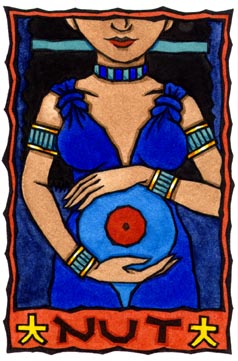
Nut is the ancient Egyptian Sky-Goddess; this is Her second appearance here, the first being last Valentine's Day (or Lupercalia Eve, if you prefer). She is one of the nine primeval Deities of the creation myths of Heliopolis. (Though the name Heliopolis is the one usually used, it is the Greek one; the old Egyptian name was Iunu Mehet or On. It is the modern Tell Hisn, a suburb of Cairo now). Several regions or cities in ancient Egypt had their own creation myths; in Iunu Mehet the story went like this:

In the beginning of days there was only Nun, the watery abyss, Whom the Egyptians called the 'eldest father'; out of Nun the Sun-God Atum emerged. Atum then created a mound of silt, which was the first land; after this He created two Deities, the Air-God Shu ('Dry'), and the Moisture-Goddess Tefnut ('Moisture'). From these two were then born another pair, Geb, the Earth God, and Nut, the Sky Goddess.

Geb and Nut then coupled, quite passionately.

In a slightly different strand of the myth, the Sun God Re (also of Heliopolis, and equated with Atum) then had Them forcibly separated by Their father Shu, the air, for He feared being overthrown by Their children. He further cursed Nut, and forbid Her from giving birth on any day of the year.

Luckily Thoth (Tehuti), the very clever God of Scribes, made a bet with the Moon and won, thereby gaining enough light to create five more days, bringing the total to 365 when it had been a nice even 360, or twelve months of thirty days each. (Of course 365 days is not the actual length of the year, it being more like 365.25 days, and they knew it; but the ancient Egyptians loved their round numbers and their order so much that, honestly, they kind of just let it slide). So Nut was able to give birth at last, and bore Osiris, Isis, Seth, Nephthys, and the elder Horus. Nut and Her five children, plus Geb, Tefnut and Shu, were considered the Heliopolitan Ennead ('group of nine Gods of Heliopolis').

Not counting Nun, apparently, and not naming the mound as the first bit of dry land, either, oddly enough.

As Sky Goddess Nut was said to swallow the Sun each night and give birth to it the next morning, making Her body, though the sky, in some ways a form of the Underworld; She was sometimes depicted as a sow, as they bear innumerable young (here equated with the stars) and have a reputation as cannibals who eat their young, as Nut alternately swallows the Sun (to bring night) and the stars (when it is day).

This week then is about waiting, pregnancy, and the anticipation of a good thing, I think, even if (like me) you have no desire ever ever ever to become literally pregnant yourself (or if, you know, you're a dude or something). Something Wonderful is coming—it is, in fact, just around the corner. The best part is that it's not something out of the blue, but something you have been working towards for some time that is about to bear luscious fruit.

Not, incidentally, that you need to do much about it at this point; it is, pretty much, inevitable that it comes at the appointed time. And that means whether you work at it or not at this point. Sure, keeping the momentum going is a good thing; but if you are tired or worn out, know that if you are unable to keep up your former pace now it will make little difference.

You may not even know you have been doing this work, incidentally. It may be one of those things that have been working themselves out on a deep dream-level, in your unconscious mind; perhaps something along the line of realizations about past circumstances that give you a new strength and purpose.

Just relax, and let it come, and be its own thing. Though like a child, it will almost certainly not be quite what you think it will be.

What does She say?

You are all my children. You are all born from me, as innumerable as the stars; and when your long day-life is over you will all come back to me, stars and gods and humans, devoured by the dark to be reborn sure as sunrise. Always devouring, always giving birth; it is the way of things, to be dark and light, joyous and fearful in their times. Though the fear is not really necessary, you know.

Granddaughter of the Void, they say; and I bear His nature, never forget.

Thursday, August 5, 2010

Off For A Bit

I'm about to go out of town for the next couple of weeks, which means that posting (and comment moderating) will be off until about mid-August. See you when I get back!

Sunday, August 1, 2010

Goddess of the Week


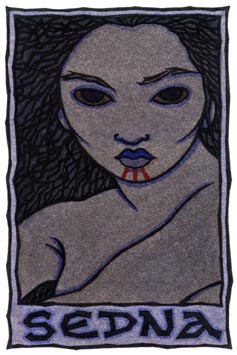
This is the first time Sedna, the Inuit Goddess of the Sea, has come up as Goddess of the Week. She lives at the bottom of the Sea in Her realm of Adlivun, the land of the dead, and She has control over all the animals of the Sea. She is the Inuit Great Goddess.

The Inuit, who live in the Arctic regions of North America, from Alaska to Greenland above the tree line, are popularly known as 'Eskimos'; however, this is generally considered a slur, as it means 'Foul eaters of raw meat' (a name given to them by the Algonquian Indians). 'Inuit' isn't quite right, either, as it's a little more narrow than 'Eskimo', but it is better, and I use it here. It derives from the word inua, meaning indwelling spirit.

Though most Great Goddesses are Earth Goddesses, Sedna is a Sea Goddess, which makes sense given the harsh climate that has forced the Inuit to turn to the Sea and its bounty to survive. As befits the Goddess of any Sea, but especially one so cold and harsh, Sedna is a mercurial, sometimes malevolent Goddess, Who can both give and withhold Her blessings.

The more well-known story of Sedna is from Greenland, where She is known as Nerrivik, a name which means 'Food-dish'. Nerrivik was once a lovely maiden who was reluctant to marry. She was finally persuaded by a handsome suitor; but when she went with him to his home she found she had been tricked, and he was a petrel-spirit in disguise. Her father and relatives found out, and rescued her; but on the way home the petrel-spirit raised a great storm which threatened to overturn their umiak (hunting canoe) and kill them all. In a panic and desperate to save himself, Sedna's father threw her overboard in an attempt to appease the petrel-spirit; but Sedna grabbed hold of the side of the umiak. Her father then took his axe and cut the ends of her fingers off. She still held on; he cut the rest of her fingers off. Still she held on, and he cut off her hands; unable to hold on anymore she then sank to the bottom of the Sea.

Her fingers and hands became the sea-animals, the seals, walruses, and whales; and Nerrivik became the Goddess of the Sea and ruler of the land of the dead.

A lesser-known story of Sedna is that She was the daughter of two giants and was born with an insatiable appetite. So insatiable and greedy was this appetite that Her parents were wakened one night to find their infant daughter attempting to eat them. Horrified at Her cannibalism, they took Her far out to Sea and threw Her overboard. Again, She clung to the side, and Her father mutilated Her, cutting off Her fingers, joints, and hands, which as above became the animals of the Sea.

When times are scarce, and the hunters cannot find any animals, the angakok or shaman of the people journeys to Her realm. This is a hard path, full of dangers, including an icy whirlpool and an abyss that can only be crossed on the edge of a knife, but if he or she makes it before Sedna, he or she then massages Her limbs and combs Her hair to soothe Her. If She is pleased, She can then be persuaded to tell the angakok one of two things: that She will send the animals, or that the angakok's people must move their settlement to another area.

She is also called Arnarkusuagsak ('Old Woman') and Nuliajoq.

The key, I think, in Her story is that though the environment is harsh and unforgiving, still, compassion plays a role. It is compassion that is given Her when the angakok combs Her tangled hair, as without hands She can no longer do it Herself. In some stories the angakok dances before Her, helping Her to forget Her harsh existence for a while.

Should you find yourself this week journeying to that dark cold realm inside you, remember to treat what you find there, the discarded, the hurt, the mutilated, with compassion.

Also, I think, have respect for those aspects of yourself, too. So often the metaphor is of going into the dark places and shining a light; this sounds in this case to be unnecessary, rude even, like suddenly shining a flashlight in someone else's eyes. Let your own eyes adjust in this case, and acclimate yourself to the dark. You will see more, and with more subtlety, if you do. Remember that though it is a part of you and you have the right to be there, that you are in some ways a guest, too. Do not just barge in and start demanding answers. Be respectful of what and who you find there.

What does She say?

She is the swell of the Sea, dark and huge; I can feel my body swaying, like you do after spending an afternoon swimming at the shore. She has dark eyes, like a seal, and does not smile.

You must understand, I did not give the animals freely. They were taken from me, and are mine, and I want them back, as I want the pieces hacked from me returned so that I may be made whole. You know this, you who discover truths; to live you must kill your brothers and sisters, the animals, the plants. You must kill me.

Though I endure. I am here at the bottom of the Sea, the cold, dark, icy Sea. Do you not think I have died? This realm is the realm of the Dead, is it not? How should I be here but that I am also dead, and that my injuries, my mutilation, have killed me? Does that not also mean that the animals who were my fingers, my joints, my hands, are all that is left of me alive?

You see why I do not let them go easily.


References:

Native American Myth and Legend: An A-Z of People and Places, by Mike Dixon-Kennedy

Recipe for Lughnasadh

No, it's not for sun-dried tomato herb bread, or little saffron rolls shaped like the Sun, but it does use the first of the tomatoes from my garden and some home-grown fresh sage.

Really I just threw this together this afternoon, but holy MOLY it was so delish that after I ate it I spent the next few hours desperately craving more and so found myself outside with a flashlight picking more sage. I'm eating it right now.

It's pretty simple, and goes together real fast.

Pasta with Browned Sage Butter, Tomatoes and Parmesan Cheese

And that's all the ingredients right in the title. Instructions are for one serving, since that's what I made but you can multiply as necessary.

Put pasta of your choice on to boil.

In a skillet, heat oh about 1/3 stick butter (three tablespoons or so, or more if you want; enough to act as sauce for your pasta) over lowish medium heat.

Wash, dry, then chop up about a dozen sage leaves, then throw them in the butter, where they will fry and become crispy. Keep an eye on it as it cooks, since you are trying to brown the butter, which can be tricky. It can take a while, which is a pain, but it's better to do it slowly than to burn it. The butter will get to a point where it's foamy; start watching then. The milk solids will start to precipitate out and turn brown, and the whole thing will smell nutty. You don't want it too brown, but it ought to be a little more than golden. You'll smell it. Take it off the heat when you think it's good.

In the meantime roughly chop a bunch of fresh, room temperature, never been in the fridge tomatoes. Throw them into the butter when you take it off the heat to warm up a little.

Grate a decent sized pile of parmesan (I used the smallest holes on the grater, so my pile was pretty fluffy), then, drain the pasta, throw it in a bowl, pour the butter/sage/tomato sauce on top, then the cheese. Mix it all up and eat!

Sunday, July 25, 2010

Goddess of the Week


Al-Uzza is the Arabian Goddess of the planet Venus as the morning star from the time before Islam. Her name means 'the Mightiest One' and She was one of the main Goddesses of the Nabateans, an Arab people who lived in the area of Jordan and northern Arabia from about the 4th century BCE to the 3rd century CE. Their capital was the rock-cut city of Petra in Jordan; al-Uzza was likely the patron Goddess of that city.

She has come up twice before here as Goddess of the Week; once in January 2009 and again in December of the same year.

It is a little hard to be definite about al-Uzza; the evidence is distant and confusing, and there is a fair amount of disagreement even among the experts.

In Islamic sources (i.e. late sources), the Goddesses al-Uzza, Allat ('the Goddess' or perhaps 'High One') and Manat (probably 'Fate') are considered separate sister Goddesses, with Manat the eldest, Allat the middle sister, and al-Uzza the youngest (or the one Whose worship was the youngest). They are even called the daughters of Allah, and in fact there was a famously redacted Sura in the Koran speaking of Them, the so-called 'Satanic Verses'. (Even Islam found it difficult to completely eradicate the underlying Pagan beliefs of the earlier culture.)

In early Islamic times al-Uzza was the main Goddess of the Quraysh tribe, from the area north of Mecca, while Allat was worshipped by the Thaqif tribe from Ta'if, about 60 miles southeast of Mecca. All three were said to have 'idols' in the Ka'aba at Mecca, that mysterious cube at the center (literally) of Islamic worship. The Ka'aba was already a major center of pilgrimage before Islam, and was apparently a Pagan temple or shrine, as it was said to house 360 'idols', which Mohammed had cast out and destroyed. The Quraysh, in particular, were said to invoke all three Goddesses as they circumambulated the Ka'aba.

It should be noted that the forms above are the Islamic versions of the names; the Nabatean versions are al-Uzza, Allatu, and Manotu (or Manawatu).

The Greeks of the time identified al-Uzza with their Aphrodite Ourania, Heavenly Aphrodite, presumably because She was a Goddess of the planet Venus, and Allat with Athena (I have no idea why). Al-Uzza, at least in Petra, also seems to have been associated with, or at least shared some iconography with both Isis, the Egyptian Great Goddess, and the Greek Tykhe, Who started out the Goddess of Fortune, but Who later took on a role as the guardian spirit of cities.

Allat and al-Uzza in a lot of ways blur into each other, and it may be that al-Uzza was originally a title of the Goddess Allat, Who splintered off into a distinct Goddess. Some scholars believe that al-Uzza was the main Goddess of the Nabateans, though She was known throughout Arabia, as a Sabaic (southern Arabia, modern Yemen) form of Her name is Uzzayan.

A late fragment of poetry mentions al-Uzza and Her 'two daughters'. There is debate as to Who Her consort was; perhaps it was Dushura, the mountain God, and Her two daughters may be Allat and Manat.

In Petra there are numerous dedications to al-Uzza (and none to Allat); the so-called 'eye idols' are assumed to represent Her.

She is sometimes called a warrior Goddess, though I'm not sure now where that comes from; perhaps it is by comparison with Ishtar, also a Goddess of the planet Venus, as well as the meaning of al-Uzza's name, 'the Mightiest One' which does sound appropriate to a bellatrix, it's true. But I haven't found anything that supports it in the more scholarly sources (as opposed to the more popular sources) and that's one reason I redid the artwork last year.

This week both grounding and growth are needed. Remember that a tree cannot grow tall without the support of its roots, and that the depth and size of the root system of a tree mirrors the height and size of its trunk and branches. There is just as much below the surface as above. As below, so above, in this case. Thinking about things in that order will I think make sense of your current circumstances.

So, keep your feet firmly planted on the earth, but look to that star shining above you. Take your cue and inspiration from its rhythms, as well as the rhythms of the earth. It is a curious sort of balance called for this week, I think.

What does She say?

I am the Stone, the solid, the square, the haunted djinn-block. The sands shift around me but I may not be moved. I am that which is constant and unmoving.

And I am the Star, the bright, the shining, the distant one. I wander through the heavens to either side of the Sun. I am that which is constant and moving.

I support and I shine. Look to Me in both these places, in the Stone beneath your feet and the Star high above. And remember I am the Mighty One. Call on Me!


What do you think?


References:

The Religion of the Nabataeans: a Conspectus by John F. Healey. Accessed through Google Books, alas. Imperfect, I know. But the damned thing is a $200 book!

Also, again, The Book of Idols, by Hisham ibn al-Kalbi. Again, warning on that site; though this part is just a straight-up translation without commentary of the original book, the site itself is some Christian propaganda anti-Islam site. The only other on-line version I could find of The Book of Idols had no paragraph breaks and crashed my browser.

Tuesday, July 20, 2010

Goddess of the Week


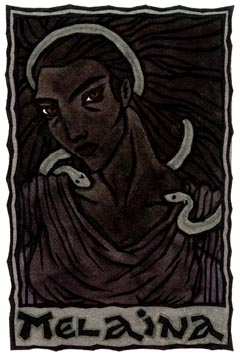
Melaina is a dark, angry aspect of the ancient Greek Earth Mother Demeter, which She took upon Herself in response to a time of great pain. She has come up once before, in November of 2008, the beginning of the dark time of year here in the north.

One of the most well-known myths of Demeter involves Her beloved daughter Kore, Who was abducted and raped by the Underworld God Haides when just a girl, vanishing without a trace into His realm under the Earth.

When Demeter found Her daughter suddenly gone, She dropped all Her duties as Earth Mother and began the long search for Her, wandering the earth in frantic grief. But She received little help; for Kore had been abducted with the tacit approval of Zeus, and few wanted to cross Him.

In the midst of this dark time, the Sea-God Poseidon conceived a lust for Demeter. When, unsurprisingly, She was in no mood, He pursued Her; and though She tried to escape from Him by taking the form of a mare and running with the wild horses of Arkadia, Poseidon soon enough found Her, and in the form of a stallion He raped Her.

This was simply too much for Demeter, on top of everything else She was going through, so She clothed Herself in black and shut Herself up in a cave in Mount Eliaos, near to the town of Philagia. From the rape She bore two children: the immortal horse Areion or Arion, Who could speak like a human, and a daughter, Whose name has not come down to us. Not, for once, because She was unimportant, but because She was considered a most holy maiden, and Her name was secret, given only to initiates into Her mysteries. They have kept that secret, and Her true name is not known. Her title, however, has survived: Despoena, the Mistress.

Demeter was eventually coaxed out of the cave by the Moirai, the Fates; They are said to have persuaded Her with Their words, perhaps reminding Her that while She was in hiding, and while Her powers of fertility were withdrawn, the crops of the world (and so the people of the world) were dying. That is the usual story, anyway; I am more inclined to think the Moirai did not persuade Demeter with talking, but by listening to Her.

This is a very dark and violent tale; and I suspect it has been quite twisted in a particularly patriarchal way. But this time the casualty is not just the Goddess, but the God as well, Poseidon. There is evidence that He and Demeter may have formed a cult pair in early times; Their names are mentioned together in Mycenaean Linear B tablets from Pylos, Their names written in that syllabic script as Da-ma-te and Po-se-da-wo-ne. Poseidon's name means 'Husband of Earth' or 'Consort of Earth', and even in classical times He was remembered for His connection with the Earth, as the 'Earth-shaker', Ennosigaios, the God Who brings earthquakes. I suspect Their relationship was in earlier times rather less antagonistic.

The Phigalians accounted that cave sacred to Her, calling Her Demeter Melaina, 'the Black', supposedly after the black clothes She wore; and they set up a wooden statue, described by Pausanias in the 2nd century CE thus:

The image, they say, was made after this fashion. It was seated on a rock, like to a woman in all respects save the head. She had the head and hair of a horse, and there grew out of her head images of serpents and other beasts. Her tunic reached right to her feet; on one of her hands was a dolphin, on the other a dove.


Melaina is Demeter in Her chthonic aspect, literally meaning of the Earth. She appears dark and monstrous, but it should be remembered that the serpents and horses may simply be symbolic of the earth.

Go into the dark a little this week. It may be that it is time to bring a traumatic or difficult aspect of your past to the light, where it may be healed; conversely, it may instead be a time to shut yourself off from the world. It is hard to tell, and can go either way; be gentle and compassionate with yourself, and do not do anything if you are unwilling, or if you are not truly ready. You will know. If you are unsure, don't.

The dark is, as it ever is, not nearly as frightening as your fears make it out to be; keep that in mind, also. Also keep in mind that acknowledging something is as good as accepting it in a lot of ways. It needn't be that difficult. You might be surprised.

As ever, I ask Her what She would like to say.

Darkness, it is all darkness. But of your own choosing; your anger, your pain, your hiding, your hibernation away from the light, your rest, your time of healing. Sometimes shutting yourself away from the world is necessary. Sometimes, even, stewing in your own anger is necessary. Do not be afraid of the dark, in all its manifestations. It is an aspect of Me, always.

Tuesday, July 13, 2010

Comment Moderation Enabled

'Cause I'm sick to death of the ?? spammer comments.

To the asshole who keeps spamming my blog comments:

This means that no one but me will ever see your comments. You may as well not waste your time, correct?

Also, may you get what you deserve, thrice over.

Monday, July 12, 2010

Goddess of the Week


Idun, the Norse Goddess of springtime, renewal, and eternal youth, makes Her third appearance here as Goddess of the Week; though She is Goddess of spring, She keeps showing up in summertime, Her first appearance being June 29 of 2009, and Her second on August 24th of the same year. She is said to grow the apples that keep the Deities young, which She keeps safe, giving them out when needed.

Idun is the daughter of Ivald, one of the Dökkálfar ('dark elves') or Svartálfar ('black elves'); they were generally considered to be the same as, or generally confused with, the dwarves, though if you're a Tolkien fan that may seem incomprehensible; in Norse myth the Dökkálfar/Svartálfar/dwarves were said to have been born from the maggots that fed on the corpse of the primeval giant Ymir, out of Whom the world was created. They are called 'black' or 'dark' both because they did not like the light, and because they were thought spiritually unenlightened; in myth, daylight turned them to stone, so during the day they dwelled underground.

Idun is mentioned in stanzas six and seven of the Hrafnagaldr Óðins, or The Incantation of Odin's Ravens, a late Icelandic poem:

In the dales dwells
the prescient Dís,
from Yggdrasil’s
ash sunk down,
of alfen race,
Idun by name,
the youngest of Ivaldi’s
elder children.

She ill brooked
her descent,
under the hoar tree’s
trunk confined.
She wuld not happy be
with Nörvi’s daughter,
accustomed to a pleasanter
abode at home.


I could find no mention of Idun's mother, but She must not have shared Her father's (and brothers') intolerance of the sunlight, for not only is she said to have lived in the dales or valleys, but 'Nörvi's daughter' refers to Nott, the Goddess of Night.

She is called above a Dís, usually translated as 'lady' or 'Goddess'; the Dísir as a class are a bit difficult to pin down, but are female Deities or spirits Who may have roots in the dead, or in Goddesses of the earth; Freyja was called Vanadís, or 'Dís of the Vanir' in Her role as fertility Goddess.

The Hrafnagaldr Óðins tends to baffle scholars, who can't even agree on an approximate date; it may describe Ragnarok and the ending of the world. The stanzas about Idun above seem to refer to an unwilling descent into the earth at that time, one She had foreseen; as She is the Goddess of springtime and youth, this may refer both to the ending of the Deities' lives, and the coming of the Fimbulvetr, the three-year-long winter that will usher in Ragnarok.

Despite Her family's unenlightened origins, Idun was considered a major Goddess; She married the God Bragi, son of Odin and the giantess Gunnlod, and had a place at the feast table in Ásgarðr. She was well-loved by most of the other Gods (though Loki lit into Her once without cause), though one wonders how much that had to do with the fact that She held the apples that guaranteed Their eternal youth.

I wonder. Her name means 'the Ever-Young' or 'She Who Rejuvenates'; how much of Her is based in an Earth-Goddess (for want of a more precise term)? She is a daughter of the earth-dwelling Dökkálfar, She tends to and harvests the apples of youth Herself, and there is a story of Her descent into the earth at the root of Yggdrasil. The Earth of springtime might certainly be called She Who Rejuvenates; and spring itself, though young each year, is ever-ancient in its cycle.

So what does that mean for this week? Though it is summer (or winter in the south), look to a current cycle; something is in a springtime phase, now, one of renewal and rebirth. But a gentle kind, less a painful sloughing of skin like a snake, and more the refreshment of a good night's sleep. Look also to the echoes of past cycles in this one. For example, I was quite surprised to find, in comparing journal entries over a year or two, that the same very specific mood (down to a liking of moody black and white photos!) would come up at the same week from one year to another. Now is a good time to see the similarities across the years; see what you can find. It will help make sense of what is happening now.

What does She say?

Be renewed. I am the Goddess of stem cells, that heal, renew, repair. I am rejuvenation; I am hoarded health. You may call on it now, that which you have kept saved. You are stronger than you think. Tap into it now, if you need it.

All is well. The new grows from the old; the new destroys the old as it grows. Health destroys disease as it grows. All is well.

There is always the new. Never fear.


What do you think?


References:

An Introduction to Viking Mythology, by John Grant;

bit of Wikipedia, again, though it was significantly less helpful this time;

and the Benjamin Thorpe translation of the Hrafnagaldr Óðins accessed at Northvegr

Monday, July 5, 2010

Goddess of the Week


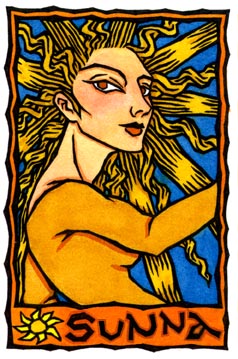
This is the first time the Germanic Sun Goddess Sunna has come up; appropriately enough up here in the north the summer is just getting started. The sun is high and what is usually the hottest month of the year has begun.

Sunna is the personified sun in Germanic myth, and Her name, as you may have guessed, means 'Sun'; She is said to be the sister of the Goddess Sinthgunt, about Whom not a whole lot is known, though She may be either a Moon or Star Goddess (the former being problematic as the Moon was generally thought to be male in the Germanic/Norse system). Both of them are mentioned in the Merseburg Incantations, medieval German magic spells from the ninth or tenth centuries; in them the sisters, with Frija, Volla, and Wodan (Freja, probably Fulla, and Odin) cure the horse of Phol (possibly Baldr), which had sprained its foot. So Sunna, then, was at least thought to be skilled in magic, and to have healing powers.

In closely related Norse mythology, the Sun Goddess is called Sól, which also means 'Sun'. Here is Her tale:

At the very beginning of things was Ginnungagap, the Abyss; it held at once everything and nothing. Out of the void came Yggdrasil, the World Tree; self-created, it would run through the center of all the nine worlds.

At Yggdrasil's southernmost root was Múspellheimr, a land of heat and fire, from which embers constantly drifted; these embers in turn melted the ice of Ginnungagap, and the quickened steam and water became the first of the frost giants, Ymir. At the same time a cow, Audhumla, was created; She fed Ymir with Her milk, and licked at the salty blocks of ice, within which was another creature, Buri, the ancestor of the Gods. After three days licking Buri was wholly freed of ice; but in this time the sleeping Ymir had created both the first humans (in this version, anyway) and a six-headed son named Þrúðgelmir, Who then 'gave birth' to Bergelmir, the ancestor of the frost giants.

Buri also had been busy, and had had a son, Börr; the two lines, then, frost giants and proto-Gods set themselves at war, as is perhaps inevitable in Norse mythology. The war lasted for the usual mythical aeons, but then a giantess named Bestla married Börr and by Him had three sons: Odin, Vili, and Ve. With Their help Ymir was killed; and from Ymir's body Odin, Vili, and Ve created our world, Midgard, the world of mortals. And, and this is where this all becomes relevant, from the brightest of the embers of Múspellheimr, They created Máni, the Moon, and Sól, the Sun.

Máni and Sól were then charged with driving the Moon and Sun across the heavens in chariots. Sól's chariot is drawn by two horses called Árvakr ('Early Awake') and Alsviðr ('Very Quick'), but like Her brother She is pursued by a wolf; at times he nearly catches up with Her, which is said to cause eclipses. It is foretold (or has already come to pass) that at Ragnarok the wolves will catch up with Them and destroy the Moon and the Sun.

I will note that as is annoyingly usual in some patriarchal creation myths, the female element has in large part been disappeared. Þrúðgelmir, after all, cannot 'give birth' alone, can He? And if 'He' did then by definition He's a She, isn't S/He? I know, pesky logic. The Norse myths were written down for the most part fairly late, at least a couple centuries after the lands had already been Christianized; like Welsh myth, it can be hard to discern the underlying layers (and I am no expert in Norse myth, trust me). So I don't know if there is something more under there. It is, certainly, a heavily Indo-European tradition, which makes it especially remarkable that the Sun is coded as female and the Moon male. At any rate.

I very much want to interpret this card as a positive sign, of rising fortunes and brighter times this week; but I keep coming back to the fact that this is Norse myth, where the warmth never lasts and all the world begins and ends in ice. However, I suppose, though the summer in the high north is not as warm as it is further south, the Sun is out for far longer in the summer days; this year on the solstice in Stockholm, Sweden, the sun rose at 3:31am and set at 10:09pm, making the day more than eighteen and a half hours long. Perhaps then, this is more about light than heat. What is being illuminated now? What can you get a good, long, look at now?

What does She say?

I draw the darkness after me. This is not frightening, or terrible; it is just night, and night is normal and natural. You need not fear if the light does not last. For though it may not seem it I always come again. Sure as sunrise, don't they say?

Enjoy me while you can. This also, is not terrible, nor a threat; simply a reminder to appreciate what you have while you have it. Your day in the sun is now. Live it, enjoy it, bask in it. Let yourself be warmed.


What do you think?


References:

An Introduction to Viking Mythology, by John Grant;

and surprisingly enough, Wikipedia is pretty thorough on Norse myth.

Thursday, July 1, 2010

We Interrupt Our Regularly Scheduled Goddess Stuff

Yeah yeah, Goddess blah blah Serious Scholarship blah blah Deep Thinky Mystery Religion Stuff blah blah blah and et cetera.

So (ha!) this isn't Pagan (probably. Maybe it is; I don't know). But I am speechless and simply must share. I absolutely cannot keep this in.

See, I know the band below (well not personally), and have been listening to the pre-1976 stuff for years; yet somehow I never actually thought to look up a live performance on YouTube. And so I'm just stunned, though really I shouldn't be.

I went to high school in the 1980s. So (ha again!) I first knew this singer from that time period, and that is the image of him I'll probably always hold in my head. I mean, sure, I had heard the guy used to have a predilection for red cocktail dresses and fox masks, but still. Damn.

Because the mad March merry hare scrawny adorable long-haired pixie in the glam makeup is fucking Peter Gabriel. With that angel's voice of his mature and unmistakable though he is only twenty-three years old. Unbelievable.


P.S. I don't want to hear anyone say, Peter Who??? and then whine about being born in the 1990s or something. Oh, and get off my lawn!! Damned kids.

Monday, June 28, 2010

Goddess of the Week


Kore is the cult name of Persephone, the Queen of the Underworld in Greek myth, in Her aspect as the Goddess of springtime and daughter of Demeter, the Goddess of the Earth and agriculture. She last came up in the early spring, which I thought at the time a fairly literal sign of the changing seasons; this time, as it's just after Midsummer's, I'm more inclined to interpret it a little more abstractly.

Kore, Whose name simply means 'Maiden,' was just a girl when She was abducted and raped by Haides, the King of the Underworld. Demeter, in Her grief, rage, and worry for Her daughter, dropped all Her usual duties to find Kore, which meant that while She searched, the Earth and its crops, and the people dependent on them, suffered. As did the Gods, in time, when humans could no longer manage to make sacrifices to Them (what with the starving and all). This, incidentally, was the reason Zeus eventually relented and ordered Haides to return Kore—not so much that the humans of the Earth were suffering greatly, but because He wasn't getting his special snowflake honors. Dick.

When Kore was finally returned it would not be wholly, for She had eaten several pomegranate seeds while in the Underworld, and Divine Law decreed that whoever had eaten there was compelled to remain. But Demeter would not hear of it, and threatened the Earth with permanent barrenness, so a compromise was reached: Kore would spent part of every year in the Underworld, and the rest on the Earth.

This was given as the explanation for why the different seasons exist—for while Kore is in the Underworld, Demeter, still outraged by Her daughter's abduction (as well as, one suspects, the subsequent 'compromise') withholds Her gifts and it is winter; but When Kore is released back to the upper world, Demeter welcomes Her with the luxuriant growth of spring.

Of course, Persephone was most likely the Queen of the Underworld first, not second; but myths can be like that and get things inside-out. Her tale of abduction and release of course also formed the thealogical basis for the Eleusinian Mysteries, which promised its initiates a life after death, based on (probably) the idea that Persephone, Goddess of the Dead, goes on to give birth in the Underworld. There is Life even within Death.

At the final point in the Mysteries, initiates were shown a cut ear of wheat as epiphany. The symbolism of the cut grain is very complex, of course; part of it in this story is that it represents the point in the cycle that is both beginning and end, where the grain is ripe, cut, harvested, and can now serve as food; but at the same time it is a seed, the beginning of the next generation and the key to continuity though it is now dead and cut. Which is why Mother and Daughter in this tale are so close, and depicted in art both as adults, the Mother and Her grown Daughter; They are in many ways the same figure, just at different points in the eternal cycle.

There are so many layers to this, so many spiraling cycles, of course; another one is that even while Persephone is underground, buried, She represents the Seed biding its time, that little thing, that germ, which contains within it the entire pattern of the full living thing, and which though it may appear to be inert or dead, is quite definitely alive.

Sometimes I think that all religion boils down to that one little idea, the Seed.

This card this week means a corner has been turned. Though it is (officially) modern summer up here in the north, the theme is yet that of springtime, of emerging from a dark place into the light to a place of growth and thriving. Especially, I think, as far as health and the body are concerned, our own little personal pieces of Earth. Things are improving, and healing, and getting better all the time. If this does not feel true for you, nevertheless know that it is, and that after a space you will almost certainly be able to look back on this time and trace back to the one little thing that changed it all, though it may seem insignificant now. Trust, I think, is a large part of this.

As ever, I ask, What does the Goddess have to say?

Put your feet on the earth, get your feet good and grounded; you must be grounded first for growth to occur. Preferably at the proper planting depth for you. Work on this, this grounding. Connect. Feel the Earth, your home, my home, our home. You need a strong foundation to simply stand up straight, which you must do before you can expect to build upon it. Feel it; it is yours, your birthright. You belong here.

Once you can do that, then you can unfurl into the light, the rain, and the air. So many get the order incorrectly, then wonder why things collapse around them. You must start with the basics; they form the base, after all. Air, Light, Water, Food: seek these and the balance of them now.


What do you think?

Monday, June 21, 2010

Goddess of the Week


Well now that makes sense. The faeries are legendarily quite active around Midsummer, especially on the Eve. The veil between the worlds is said to be quite thin now, as well. I've always thought that it's because in the northern lands (and even here in New England, which isn't all that far north really) at Midsummer the sky never quite gets entirely dark, and keeps a bit of that luminous twilight glow to it even in the wee hours. And if there's one thing the faeries love it's the twilight and the in-between places.

I'm not sure there's much more to add to that. Get out this week into nature, and find that twilight liminal realm for yourself. Spend some time with the magical, the wild, the overgrown and the in-between, whether in the outer world in its green tangle, or the inner world of dreams and visions. Seek the memories of magical times, or the luminous dreams you once had; it will be restorative to the soul.

What do They, for They are always plural, say?

Leave some garden for the groundhogs.


Well I suppose we can't expect 'serious' of the faeries, can we? Still, that's in line with leaving the last apple on the tree for the apple-tree man, isn't it?

Sunday, June 13, 2010

Goddess of the Week


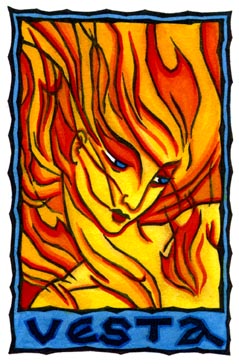
This is the first time Vesta, the Roman Goddess of fire and the hearth, has come up. She held a central place in Roman religion: Her round tholos temple was set in the heart of the Roman Forum, and a perpetual flame was kept burning there. She has Her equivalent in the Greek Hestia, and unlike many of the other Roman Deities Who were equated to Greek ones, the two do seem to stem from the same root, and have some similarities in worship as well as name. As the hearth is the primeval altar, both Vesta and Hestia held places of honor in rituals involving more than one Deity, if at opposite ends of the rite: for while the Greeks invoked Her first in ritual, the Romans invoked Her last.

As Goddess of the hearth and the hearth-fire Vesta represents the heart and the center of the community, whether the home and family or the state. She also symbolizes the communal meal, as the hearth is where bread was baked; and in time She became somewhat of a patroness of bakers. On Her holiday on June 9th (just last week!) millstones were decorated with garlands, and loaves were hung about necks of the asses responsible for turning them.

She was one of the few Roman Deities to have no image; the naked flame was taken to represent Her.

I think this week is about being grounded in fire, though that may sound an odd thing to say. Vesta is about the center and the hearth and the flame that burns there. One normally grounds in relation to the earth; but remember that at the center of this planet deep fire burns. Tap into your own fire this week; it will be more centering and more stabilizing than you might think.

Vesta's rites were overseen by women: the famous college of Vestal Virgins. It was women's work to hold the center of Rome sacred and true. Remember that also this week.

What does She say?

Burn hot, burn warm, burn fierce, burn gently. All of these things are Me. I hold to the center; it all turns around Me. I am first and I am last if you are to do anything well and truly. Honor Me by honoring the sacred fire at your own center, your heart, the fire in your belly, that infinitesimal yet infinite Star at the center of the Soul. I live in each of you. Honor Me by honoring yourself.


Reference:

Dumézil, Archaic Roman Religion

Monday, June 7, 2010

Goddess of the Week


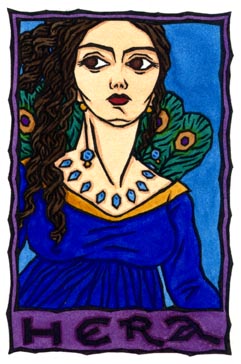
The Greek Goddess Hera comes up here for the first time. In myth Hera is the sister and wife of Zeus, the great Olympian king of the Gods, and so Queen Herself. But Zeus has a wandering eye, and Hera takes the role of the scorned, jealous wife Who savagely punishes Her husband's paramours; She has the reputation of a shrewish, jealous woman. A passive-aggressive conniving bitch driven to behind-the-scenes power plays, actually.

Well, that's the classical version of it anyway. But I think we know better by now, don't we?

The truth is that Hera pre-dates Zeus. She was the principal Deity of either sex of the area around Argos, Her Archaic temple at Olympia is earlier than the one Zeus had there, and Zeus is called posis Hêrês, or 'spouse of Hera' in Homer. The likely explanation for the structure of the later myths is that when Zeus came along, Hera, as the main Deity of the region, was joined to Him as His wife, an obvious Queen to His King. The same process may account for many of Zeus's 'lovers' (in quotes since some of Them were clearly raped): the local Goddess was joined to the new King, as expression of Her status, or by way of absorbing the indigenous religion. That the other local Goddesses kept some of Their original importance is played out in myth as the conflict between Hera as the 'official' wife and the rest as mistresses. Though Hera and Zeus are associated from fairly early times, Zeus's earliest wife may well have been the prophetic Titaness Dione.

We don't really know what Her name means, though an early form, Era is mentioned on Mycenaean Linear B tablets. It may be connected to springtime, or to a word for 'Protectress'; She is very much associated with heroes, which word is related to Her name.

She was probably originally a fertility Goddess, as much as that term is a vague one. She is associated from earliest times with cows (one of Her epithets is Boôpis, 'Cow-eyed') the seasons, especially springtime and its flowers, and to trees: She had several xoana, rough wooden statues, planks, or pillars, either aniconic or barely iconic, generally considered (by the Greeks of the time) as indicative of ancient worship.

Her story is one of uncomfortable adaptation into a new system, with Her fighting it the whole way. I am not sure what to make of it, as far as interpretation for card for the week goes; and I am inclined, as ever, to make more of origins than later interpretation. Especially since Her story is not a happy one, and She becomes locked into a losing battle through circumstance and the brutality of the culture and Her husband, Who was plainly abusive at times. So I'm not sure. Survival, perhaps, and doing what it takes to live in a gamed system may be the theme this week. But remember, if you can, that the system is unjust, even if you have to play along to survive. And that if the rules are immoral, there is no moral reason to follow them.

On the other hand, there is great value in uncovering that which is lost, or buried. Dig down to those origins if you can; what you find promises to be surprising, and healing. Find those roots, whether of the problem you are trying to work through or out, or of your own innocence or authentic self. Remember who you were, and who you are, and find the thread that connects the two.

What does She say?

I am wronged, very wronged. We, I, are all wronged, We this Earth, We the Goddess, I the Goddess, I all of Woman; We are wronged. And though it is not the responsibility of the wronged to make it right, that is the only way it will happen. Those wronging us are not about to stop of their own accord. They have made that quite clear.

So we must take what is ours. Earth will right Herself, at whatever cost; though She uses a broad brush, and will take the innocent with the guilty. It cannot be helped. Survival, after all, is first. And She may not be judged.


References:

The Transformation of Hera: A Study of Ritual, Hero, and the Goddess in the Iliad,
by Joan O'Brien, through Google Books. Oddly enough I can't find a copy for sale through the usual places. Which is really weird as it's neither too old nor too new, being published in 1993. Really, not one used copy available anywhere?

And Theoi, as usual.

Monday, May 31, 2010

Goddess of the Week


We haven't seen Her in nearly a year, but Amaterasu, the Japanese Goddess of the Sun, is making Her third appearance here. (Her other two: in July of 2009, and early November, 2008.) She is the principal Deity of Shinto, considered the foremother of the Imperial line, and said to have invented weaving, agriculture, and therefore civilization. Her name, given in full as Amaterasu-Omikami, means "The Great Goddess Who Shines in the Heavens."

Amaterasu is the daughter of the first couple, Izanami ("She Who Invites") and Izanagi ("He Who Invites"). After creating the islands of Japan, Izanami and Izanagi then desired to have a child Who would rule over all; and so Amaterasu was born. It is important to remember that Amaterasu is not just an important Goddess, but the supreme Shinto Deity of either sex; in my reprint of Myths and Legends of Japan, which was originally from 1913, the primeval couple ask Themselves "Why should we not produce someone who will be the Lord [sic] of the Universe?" since of course the Deity at the tippy-top of things must be male, from the western author's point of view.

Now, it's true, Japanese myth is not my strong suit, but my feminist nose is smelling some revisioning of the myth. In the story of Amaterasu's parents, Izanami (Her mother) and Izanagi (Her father), came together to an island. Having decided to marry, They set up a ritual pillar, which They walked around in opposite directions (it would be interesting to know Who walked sunwise, and Who walked widdershins, wouldn't it?). When They met, Izanami exclaimed, "How wonderful! I have met a beautiful young man!" This angered Izanagi, however, since He felt He was entitled to the first move, and the first speech, since He was male (and that is specifically the reason given); He insisted They do it over, and when They met the second time, He said, "How wonderful! I have met a beautiful young woman!" And this, according to the legend, made everything right with the Universe.

Yeah, well. That's a pretty literal account of men being rewarded for taking credit for something women have done first, down to the words from our mouths being stolen; and also it strikes me as a pathetically transparent justification for building a society on a sexist foundation. So transparent, that I wonder what is there to prove? It if really is just as it always has been, is there a need to justify it like that? So I wonder if this is a remnant, a remembering in myth, of a time when Japan was not patriarchal. From what I understand of history, Japan does have a matriarchal (or whichever word you choose to describe it) past; the Chinese are said to have been surprised when they first encountered the Japanese tribes, as the leaders of those tribes were often women.

Now Izanami and Izanagi's next child was the Moon-God, Tsukuyomi; and though They thought He and Amaterasu a perfect pair, They argued almost from the first sight of each other. And so Amaterasu rules without a consort. Which She doesn't need anyway, being brilliant, canny, inventive, hard-working, and an excellent archer to boot; and She always uses Her gifts to further civilization.

This week I think it will be about sunshine; specifically, the kind of sunshine that illuminates the dark places. Perhaps it will involve taking credit where it is due, or shining the light on someone else's misappropriation; it may also involve bringing dark areas of your past to light in the name of healing. It may be somewhat painful to look, I fear, but it is a good time, if you choose. Stand in the sun; be aware, and warmed, and visible. The light will prove a great source of strength.

Take credit for the good discarded or buried things that are yours, but also recognize what isn't yours--perhaps shame, guilt, or the like which you have been carrying around with you. This week will provide a very good opportunity to see things with remarkable accuracy and clarity.

She is brilliance, and warmth, and growth. She draws the flower to Her; the plants grow towards Her, longing to reach Her.

What does She say?

Reach for me, unfold yourself, unfurl yourself in my warmth. It is safe here. I am the Truth that stands in the Light, and I will not be denied. I am strong, and intelligent, and prepared to defend myself and you; and I cannot be fooled. Grow towards me; use my warmth and light to grow strong. Remember I am always here, even in the winter; and even if my light is low, I always return. Come out into the light!


What do you think?


References: Larousse Encyclopedia of Mythology