
I've been working my way through Christopher Penczak's book The Temple of Shamanic Witchcraft; this month, the third month of lessons since I started the book with the new year, is focused on the Lower World. Among other exercises such as finding your 'power animal,' (which I find I have to put in quotes because it doesn't seem like quite the right term to me), he also talks about beginning a relationship with the local fairies.
The thing about fairies, or faeries, or the Fay*, or the Good Folk, or whatever you call them in your neck of the woods, is that everyone knows, more or less, what they are, but no one can quite define them. I suppose that's appropriate, given their in-between nature. They might be nature spirits, the dwindled remains of former Gods, the Dead, all of the above, or something else entirely.
One thing that does seem to be agreed-upon, however, is that they have an aversion to iron. I have always taken this to mean that iron is a symbol of civilization and of mankind's determination to control and subjugate nature; and so as the voice of the wild, the fairies are naturally not too keen on the stuff.
Now that leaves me with a bit of a dilemma. You may have heard (or you may not have, since I imagine a few readers will have popped over from the Pagan Blog Project page), that my father was a hoarder. A hoarder who was also a mechanic, which influenced what he hoarded. Oh sure, he hoarded the usual things, newspapers, books, and used paper coffee cups, but his especial speciality was junk cars and, guess what, iron.
My sister and I have been cleaning up this yard for the last couple of years; that's a whole other blog. Hie thee over there for the gruesome details, including a video of the yard at its worst. Oh, it was bad. Trust me.
There were piles and piles of iron here, saved against Godsknow what dark future my father feared, though, honestly, my latest theory is that hoarders believe that if they save enough stuff for 'what-if' or 'someday' then they will be prepared. And by prepared I mean they think they will be able to avoid the bad stuff, because they have something saved just for that. And by bad stuff, I mean death. I really think that hoarders, or at least my father, think that if they save enough stuff they won't die.
Anyway. We've taken lots and lots of iron out of here in the last few years. By last count, and this is a real number because I have the receipts, we've brought more than seventeen tons of iron to the scrapyard. Yeah, seventeen tons. And it's not anywhere nearly cleaned yet. There's still plenty more where that came from.
The thing about iron is that is decomposes; it rusts. So even if we were at the point where we'd taken all the surface stuff away, there would still be bits and pieces of rust in the dirt. When we rake up the debris, the more we rake, the more iron and rust we find. My father hoarded this property for something like forty years; that's layer upon layer of rust, and leaves, and dirt, and I have no idea how far down it goes.
And there's plenty of iron in the soil around here anyway, just naturally. The local mill-stream runs red, and the rocks within are coated with it. We used to have well-water. I could never understand what people meant when they claimed water had no taste; to me it was this horrible metallic stuff. Once, my father put the faucet on a slow but steady dribble, then held a magnet to the side. The water bent.
And so where does that leave the local fairies? I can't imagine that any of them are going to want to come anywhere near my yard, not for a very very long time, like decades, maybe. Or if they do, or are here already, won't they be angry, really, really angry? Not that it is my fault, and yes, I am cleaning it up as best I can, but still. That much iron is not going to agree with them; it just can't.
And so I can't imagine inviting them in; it sounds, well, mean of me. Come hang out in a place that will hurt you. That's like asking your friends over when your smoke detector is stuck on alarm mode. Ouch. Penczak does say that it's optional, and something you should only do if you feel called to it; and so I think I will hold off on it for now.
I do think the fairies would approve of the clean-up job I'm doing; but I just don't think the place is anywhere near ready yet.
*Pet peeve from a Tolkienist: fey with an E describes a certain kind of who-cares-any-more clear-sighted despair due to being near to death and knowing it, for example in the late mental state of the guy of whom was said A Túrin Turambar turun ambar-tanen; it is not the same word as fay, which is another word for fairy. Maybe, maybe, under the definition of 'displaying unearthly qualities' it could be applied to fairy sorts, but, sorry, no, it's not just another way to spell 'fay.' SO STOP IT PEOPLE.
Showing posts with label Danu. Show all posts
Showing posts with label Danu. Show all posts
Friday, March 16, 2012


Monday, January 18, 2010
Meanderings
I love researching Goddesses and the sacred; I love tracing things back and back to their origins (or as close as I can get, anyway; there is always further). And so often the roots of a thing come down to place. I love following the strands, finding that one line about an obscure Goddess, the one town in which She had a concrete presence, then tracking the modern name of that town down if I can, and figuring where it was, where was Her temple, Her spring, Her wood; and then if I'm very lucky, finding a photograph someone has posted somewhere, or even, looking down on it through the medium of that wonderful modern phenomenon, satellite photography.
For example, tonight, in writing about Danu, I came across this picture of the origins of Her river, the Danube. It is a simple thing, a place where two smaller rivers come together to form a third. And though the picture looks perfectly ordinary, as if it is just some nice little picturesque scene in Germany somewhere, still, it gave me a chill:

There is something quite numinous about it.
Last week, in researching the Magdalene, I found myself looking at this glorious photo:

It is the church of Notre Dame de la Mer, in the town of Saintes-Maries-de-la-Mer, where Mary Magdalene is said to have come ashore; in the crypt is the famous statue of Ste. Sara.
And then that led to this, the satellite picture of the same church, out there in the ordinary and numinous old world:

And then by dragging the map a bit to the east, I find this:

It is hard to be sure, but I think those little white spots are some of the famous wild horses of the Camargue, standing there in shallow waters. You can see some of their tracks in the upper left.
It's a miraculous world.
For example, tonight, in writing about Danu, I came across this picture of the origins of Her river, the Danube. It is a simple thing, a place where two smaller rivers come together to form a third. And though the picture looks perfectly ordinary, as if it is just some nice little picturesque scene in Germany somewhere, still, it gave me a chill:
(Picture by Drombalan, posted on Wikipedia, here.)

There is something quite numinous about it.
Last week, in researching the Magdalene, I found myself looking at this glorious photo:
(Picture by Wolfgang Staudt, posted on Flickr, here.)

It is the church of Notre Dame de la Mer, in the town of Saintes-Maries-de-la-Mer, where Mary Magdalene is said to have come ashore; in the crypt is the famous statue of Ste. Sara.
And then that led to this, the satellite picture of the same church, out there in the ordinary and numinous old world:
(Image from Google Maps, here.)
And then by dragging the map a bit to the east, I find this:
It is hard to be sure, but I think those little white spots are some of the famous wild horses of the Camargue, standing there in shallow waters. You can see some of their tracks in the upper left.
It's a miraculous world.
Goddess of the Week
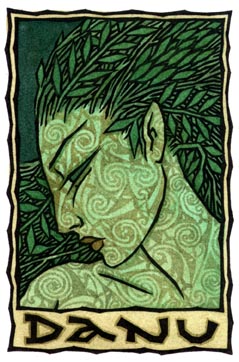
This week's Goddess is Danu, thought to be the Mother Goddess of the Continental Celts. Her name is not quite attested, nor does She have any mythology under that name; however there is plenty of indirect evidence that a Goddess by that name existed in the Celtic mythos.
The Danube River, that great river of central and eastern Europe, located in the area from which the Celtic peoples are thought to have emerged, is probably named for Her. Though it is likely Her origins are even older--there is a Vedic Goddess also called Danu, Who was the mother of the Davanas, Asuras (roughly 'demons') Who rebelled but were defeated by the Devas (approximately 'gods' or 'angels'). Upon defeat, the Davanas were cast into the oceans. The word danu in Sanskrit means 'rain,' 'liquid', or 'waters of heaven,' and is related to the names for several other famous rivers, such as the Don and Dneiper rivers of Russia, and the Dniester of eastern Europe. So She would appear to have origins in a river Goddess.
She probably found Her way into Irish myth under the name Ana, which is occasionally spelled with a D affixed to the front; as such She is the mother of the Tuatha Dé Danann, the name used for the family of the old Pagan deities of Ireland. The name means 'the people or tribe of the Goddess Ana or Danu', and Their numbers include Deities like the Dagda, Brigid, Macha, Manannán, the Morrigan, Ogma, and Flidais. Her Welsh equivalent is Dôn, also a Mother of Deities, including Arianrhod. Ireland is sometimes called for Her 'the land of Ana,' and She can grant or withhold the prosperity of the land.
Though the Tuatha Dé started out as Deities, according to legend They were later driven underground, literally, to live in the sídhe, the hollow hills; They were then called the aes síde, or 'the people of the mounds.' In time They became the fairy folk, who in modern Irish are still called the sídh, after the fairy mounds. Here I have drawn Danu in that role, as Mother of the Fairies.
The strands making up Danu are nearly lost, though we have some good guesses; and I was wondering how I was going to interpret this card in light of that. But in doing the research, I came across this line in the entry under 'Ana,' in The Dictionary of Celtic Mythology by James MacKillop (an excellent and thorough book): "Despite these pagan associations, her name is borne by the virgin St. Ana whose feast day is 18th January." Now then. That's a funny coincidence.
So then, what have we got? A Deity Who was considered central and primary to a people, Who was once the mother or leader of the Gods, though She has been much forgotten and reduced; and the startling 'coincidence' of this day, this moment right now.
Something has been brought sharply into focus. Something that touches on ancient, profound ideas. There is a connection with this moment right now and the patterns of the past. What do you see? What can you make out? It's as if two lenses have momentarily overlapped and are allowing us to see, in great detail, something we had thought lost.
Then of course there is the fairy aspect of it. It was only the week before last, in fact, that I drew the Faerie card. Though we've had the Magdalene in-between, I think this is probably in some ways a continuation of the theme of wildness and paying attention to magic; I said at the time that "[s]ome strand has looped close to the surface this week;" I think this week it has actually broken through.
I don't even really know what that means, but it feels like a rare opportunity of some sort. I would say, look around at the world of the hidden, the wild places around and within us, with clear sight (of as many kinds as you can manage), and above all pay attention.
I wonder if She can clarify.
Danu says:
Wheel, spin, watch the change. The sap is rising. Things are being born. Things are slipping through. Be ware. Be wary. Be aware. It cannot be stopped.
It must run its course. Yes, like a river--you are so clever!--a great river, that which is central to a people. No, I know nothing about that. Why would I?
Oh, yes, the veil, as you call it, it is so thin right now. I know! Now? In the middle of winter, when We should all be sleeping? But yes.
The forgotten will find you. But be aware. It cannot be stopped.
Well, I'm not sure that exactly sheds much light on anything. What do you think?
Tuesday, December 29, 2009
Goddess of the Week
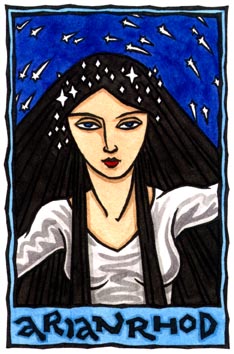
This is the first time Arianrhod has come up. She is a Welsh Goddess Whose name means 'Silver Wheel' or 'Silver Disk'; She is usually interpreted as a Moon Goddess, but I tend to see Her more as a Star Goddess, since the Moon does not turn like a wheel, but the Stars do appear to. It is hard to tell, though, since what we know of Arianrhod is through the medieval Welsh collection of tales called the Mabinogion; for by the time it was written down the old stories of the Deities had been Christianized into fairy tales. Sure, there is plenty of magic and the supernatural in the Mabinogion, but the original Divinity of some of the characters does look to have been downgraded and hidden away.
In the Mabinogion Arianrhod is a candidate to be the foot-holder of Math, a position that one has to be a virgin to hold. When She is magically tested for said virginity by Her brother, the magician Gwydion, She immediately gives birth to twins, putting the lie to Her claim. One of them, Dylan, dives straight into the Sea; the other, Lleu, is a formless thing that Gwydion claims.
Arianrhod wants nothing to do with Lleu; so Gwydion brings Him up, periodically tricking Arianrhod into giving Her son what He can only be given by His mother; each time She is tricked, She heaps scorn upon the both of Them, accusing Gwydion of perpetuating Her shame at not being a virgin by throwing Her son in Her face.
But each time Her refusals are overcome through the magic and trickery of Gwydion, and Lleu gains a name, is armed, and even obtains a wife, the maiden Blodeuwedd, Whom Gwydion and Math create out of flowers. That, however, ends rather badly (see any of the previous posts on Blodeuwedd linked in the tag below).
That, at any rate, is the story in the Mabinogion.
Now, let's first get the family relationships straight. Arianrhod is the daughter of Dôn, Who is the Welsh Mother Goddess, the equivalent to the Irish Danu, the mother of the Sidhe or faery-people. She has (at least) four brothers: Gwydion, Gofannon, Amaethon, and Gilfaethwy. Their names represent some very fundamental skills, the sort of basic building blocks of civilization: Gwydion's name means 'Knowledge,' Amaethon's 'the Divine Ploughman,' and Gofannon's 'Smith.' (I was unable to track down the meaning of Gilfaethwy's name.) Math fab Mathonwy (Math son of Mathonwy) is Dôn's brother, Their uncle, Who, like Gwydion, is also a great magician.
Remember, the tale in the Mabinogion has been straightened up for a Christian audience, the probably Divinity of the players downgraded or glossed over. There are pieces missing. And so there is no outright mention of Who the father of Arianrhod's sons might be. And while it's tempting to go the route of 'well it must be an older virgin mother scenario that was hidden in a vast Christian anti-woman and anti-Goddess conspiracy' (and while I usually do tend to that), this time I don't think so.
The internal evidence, such as it is, points to Arianrhod's brother Gwydion being the father. Lleu is in fact called His 'son' in the tale, though perhaps this refers to His position as adopted son. (And, no, I am not just making this up; I am getting this from MacKillop's Dictionary of Celtic Mythology.) Now, in myth, incest is not the same as it is in reality, where it is a taboo, shameful, horrific thing; in myth, it can simply be a shorthand way of saying the pair are considered equals, in the way that Isis and Osiris, Freyja and Frey, and Hera and Zeus were sister and brother.
But by the time of the Mabinogion that's all been buried; and there is only the barest hint of incest. What we are left with, as explanation for Arianrhod's extreme anger towards Lleu, Her own son, is Her shame at being exposed as not a virgin.
It is hard to say. Nowadays that is not considered the end of the world, or even all that important, really; though, it's true, virginity (in women, of course) certainly was very much prized in some ancient societies. But something never quite rang true for me. That alone never felt like a good enough reason for Arianrhod's utter rejection and hatred of Her son.
But when I looked at Arianrhod as the victim of rape it all fell into place. (My version of Her tale is here.) Her hatred towards Lleu, Her own innocent child, then takes the place of Her anger at Her brother Gwydion, the powerful magician Whom She can not touch.
A modern feminist reading? Maybe. Though rape is certainly not a modern phenomenon, and I don't imagine that women, being human, have had vastly different experiences of it through the ages.
There is this, though:
In a related tale in the Mabinogion, Math's virginal foot-holder is one Goewin. Gilfaethwy, however, conceives a lust for Her, and with the help of brother Gwydion hatches a scheme and rapes Her while Math is away; when Goewin tells Math what Gilfaethwy did to Her, Math offers to marry Her, elevating Her to a position of honor as queen; He also punishes Gwydion and Gilfaethwy by transforming Them into a pair of beasts for three years. Each year one takes His turn being the female and bearing young; at the end of the three years They are considered punished enough. (I don't know if Goewin, however, thought it sufficient.)
This is the situation that necessitates Math finding a new virginal foot-holder, and which leads to Gwydion's suggestion that Arianrhod apply. On one level that doesn't even make sense: if Gwydion is the father of Arianrhod's twins, then for sure He must know She is not a virgin. Is He trying to punish or shame Her further? Or is it simply a detail that has not been thought through, some piece gone missing by the time it was written down in fairy-tale form?
I have always found the psychological analysis of fairy tales fascinating; the sort of thing Bruno Bettleheim did in The Uses of Enchantment. That way of figuring dips back into very primal, archetypal ideas. Wicked step-mothers are a way of splitting off bad behavior unacceptable in an actual mother; and mothers can be further split off into more than one character. (For example, in Hansel and Gretel, the wicked step-mother who hatches the plan to abandon the children and the cannibalistic witch in the bread house are the same figure at some level.)
I've really got no evidence for this, I suppose, beyond a hunch, but I suspect that Arianrhod and Goewin are in some ways different aspects of the same character. They are both foot-holders to Math (which is in itself a puzzling title or occupation; all it says is that Math had to have His feet in the lap of a beautiful and virginal young woman. I don't know what else it is implying); They are both entangled with Gwydion, Who obviously has no scruples when it comes to facilitating rape. I mean it's all been sort of made logical and fit into an actual, non-mythological timeline; but there is something moving around under the surface of the stories. I don't know; but I find it fascinating and disturbing.
So what does my long, rambling digression mean for the meaning of this card? I don't know. Let's just go back to the card itself, for a moment.
At very first glance, Arianrhod as a Star Goddess with Her back to the North Star would seem to fit quite well with the time of year up here in the northern hemisphere, with the winter solstice just past; the idea of north, the direction defined by the Earth's axis, and the still point in the whirling about of time, that moment when the sun is said to stand still before turning back the way it came. And that fits with the whirlwind cards that have been coming up lately, Oya and Kelaeno the Harpy. Though this time, the focus is on the still point, and maintaining yourself in that space while all is whirling about you; as ever, this time of the year is a good time to go inwards into the dark and the stillness.
But the dark is also where the fascinating and disturbing lives, the layers underneath, the meanings, concepts and motivations that cannot be approached by logic but must be intuited out. I would say try to spend some time there this week, feeling out old tales of your own; pay attention to dreams, especially, but also other stories and myths (both cultural and personal) that catch your eye. Something's up. On a very basic level the year has turned; look for evidence of that turning, of a shift in the current of the psyche's Sea which may bring formerly deep things towards the surface. I'm not sure what kind of specific advice to give; I think the point is that you will have to figure it out for yourself.
Let's see what She says:
I whirl but I am not dizzy. I am solid in myself, in my anger, in my knowedge that I am right. Deep in my bones I am I, myself, me, and I know it.
It is all panic and war-plans and lies when there is in fact peace. Shoemakers misusing their skills, all a plot, a plan, a surface shuffling about of colors. It does not affect the underlying story, the reality of it. Destiny is destiny, after all, and I am the Woman with my back to the Deep, the north star, the straight line, the center, the axis; there is no fooling me, no getting around the Fate I proclaim. And so the pretty flower-woman is Death in disguise, for my Son does not escape his destiny.
All is fate and spinning and round and round the center. Trying to keep track of the whirling is a waste of time and energy, though it may be pretty; find the center. You can admire it all from there without being caught up in it. It is much quieter, here, much more conducive to thought and contemplation, which is what you need right now.
Come.
What do you think?
References:
The Mabinogion, translated by Gwyn and Thomas Jones
The Dictionary of Celtic Mythology, by James MacKillop
This isn't anything related to the Arianrhod tale, but it did get me thinking: a psychological analysis of maternal cannibalism in the Hansel and Gretel tale (as well as Snow White and Little Red Riding Hood) by Tracy Willard is here.
Subscribe to:
Posts (Atom)