Well, though I'm not a Christian it
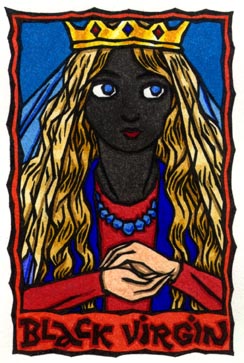
is Easter Sunday. So it makes sense that this week's 'Goddess' is the Black Virgin, a somewhat mysterious form of the Christian Virgin Mary depicted with dark or black skin. Though there can be various reasons why Her skin is dark (depending on the individual Madonna), more than a few are linked with ancient Goddess worship.
Now, I was operating under a fairly loose definition of 'Goddess' when I did these cards originally, which is why folk like Joan of Arc and the occasional Buddhist Bodhisattva have been included; but this one, particularly, has more claim to being a Goddess than most.
Black Madonnas are a mostly medieval European phenomenon, with between 450-500 of them in existence, a good part of which are in France, though there are famous examples in Belgium, Spain and Poland. Now, there are various reasons given for the dark color of Her skin, some of which are quite mundane: for example pigments changing over time, or soot from candles darkening the colors (though oddly enough in a lot of cases this seems to only affect the paint of the hands and face, not the clothing.
Hmmmmm.) Still, it's quite clear that a number of them were painted dark on purpose.
It's also clear that quite a few of the sites with Black Madonnas were at one time sacred to some form of the Goddess, mostly Isis, Cybele, or Artemis. This isn't particularly mysterious--when the Roman Empire officially dedicated itself to Christianity, the Church's policy with the more stubborn holdovers of Paganism was to adapt them over to Christian purposes. So in the same way that elements of the
Saturnalia, the great Pagan Roman winter festival, were adopted into Christmas, so churches were built on old Pagan holy sites. And if they had been dedicated to a Goddess, well it just made sense to dedicate the Church to the Christian version of the Mother, Mary.
And so then, because these Madonnas are connected with the old Earth Goddesses, the color of their skin is that of the rich, black, earth.
The Virgin of Guadalupe is perhaps the most famous Black Madonna. She is originally Spanish; but in Mexico one Juan Diego had a vision of Her in 1531, and so since then She has become a symbol of Mexico. She has been linked, incidentally, with the Aztec Earth-Goddess Tonantzin or their Great Mother Coatlicue.
I should probably offer a little bit of explanation on the art of this card. When I painted it I had in mind the Goddess Cybele, also known as the Magna Mater or Great Mother. Cybele was native to Phyrgia in central Anatolia; but the Romans adopted Her. Quite formally, actually: in response to a crisis in 204 BCE (there was always a crisis in Rome), the Senate consulted the Sybilline books, and came to the conclusion that Cybele's worship should be brought to Rome. Which they did, by bringing Her icon from Phyrgia. This icon was in the form of a conical (or needle-like) uncarved Black Stone, and was a meteorite; which I suppose makes it a conical aniconic icon.
Anyway, so that is why I only painted Her face black, to represent Cybele's Stone. The blonde hair, blue eyes and doll-like features are meant to evoke the European shell put over the ancient Eastern Goddess.
This card represents ancient secrets in plain sight, then, or the layers of the past showing through in the present; and despite the rewritten history the origins of things are easily discerned. So this week, be on the lookout for old patterns underneath current circumstances; it may not be apparent on first glance, and may require a little digging, but you may well find that what you thought was something new is actually a manifestation of an old issue or old way of doing things. Or, it may be less about old habits you're falling into and more about ancient themes of the sacred popping up in unusual or modern-looking places. I think, mostly, it is advice for the week to be aware and look closely at what is just beneath the surface, to see the patterns, habits, connections, or old ways of worship there.
What does She have to say?
I am Earthshaking Cybele, rattle your bones, bang on my drums! Rattle rattle BOOM! Dance the ecstasy, run up the mountain; you are all wild still in your bones, under your veneer of civilization. I cannot be stopped; I cannot be forgotten; I will always be here and I will always be powerful, whatever veil you throw over me. I am the Old Mountain Mother of the Mural Crown; I walk with lionesses at my side.
Rattle rattle BOOM! Let the kettledrums thunder! Every drumbeat is mine. Every drumming heart is mine. This is as it is. From the beginning to the end, it is mine.
I am the Great Mother. I always have been, and always will be. I am always here. And you are always my children, all of you. If you have need, ask. Even as a pretty Madonna, what do I do but bridge Earth and Heaven? For I am the Black Stone that fell from the Sky.
Well. She is very strong, and that was not what I was expecting. Two letters in to typing that I found I had hit the CAPS LOCK key; I turned it off but She is LOUD! I think, then, I will add to my advice above and say that reclaiming our wildness is also part of the message. Get your heart beating: go dancing, running, be loud! I am reminded of the boom of a firework, how it is so loud it almost stops the heart; but at the same time it opens the heart WIDE.
Wait a minute. I just remembered! One of Cybele's Roman festivals was the
Megalensia, held from April 4th through the 10th, marking both the arrival of Her Stone to Rome and the founding of Her temple on the Palatine. There was
also a (probably earlier in origin) festival of Cybele in March, the
Hilaria, held from the 15th to the 28th; and some of the rites of the
Hilaria are strikingly similar to those of guess what, the Christian
Easter.Well then!