Showing posts with label Skaði. Show all posts

Monday, October 12, 2009

Goddess of the Week


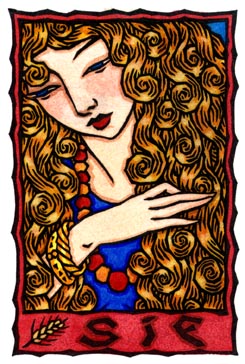
Sif's name means 'kinswoman' or 'relative'; it is related to the English word sibling, meaning 'brother or sister.' The meaning of Sif's name is a little more precise, however; it is the singular (and Her name is the only time the singular is used) of the plural Old Norse noun sifjar, which means 'relatives by marriage.'

Marriage, not blood. In the myth, Sif is the mother of the God of Winter Ullr; His father is never named, just said to be a frost-giant. Her second husband, then, and the one She was most associated with, is the famous Thor. It is always very carefully pointed out that Thor is Ullr's step-father, and Ullr Thor's step-son.

Which all has to do with the complicated ways the Norse defined types of kinship; as far as I can tell, and I'm looking at this, as ever, through a very feminist lens, this particular and careful distinction was a way of favoring the male line over the female. Because Ullr's mother married Thor, Ullr's father was discounted, to the extent that He has remained nameless in myth.

I suppose one might argue that maybe Ullr's father was never named because it wasn't a big deal, and it was more important to identify Him with Sif; I don't think the Norse thought like that, though. I don't know how old Sif is within the culture, and it may be that the relative by marriage aspect of Her is the main or original one.

On the other hand, it would seem that Ullr, Whose name means 'Glorious One' was once a very important and very old God in the Norse pantheon, though by the time the sagas &c. were written down He is only sparsely mentioned. He was, like His mother, said to be very very beautiful. And it would make sense that a Very Important God like Ullr might just have a Very Important Mother; so perhaps all that past glory of Ullr's might also indicate a greater past measure of glory for His mother. By Thor Sif did have a daughter, Þrúðr (Thrúdr), Whose name means 'Strength;' whether that reflects on the mother's or father's strength I don't know.

The thing is there just isn't a whole lot known of Sif, beyond that She had the gift of prophecy, and that story about Loki cutting off Her long golden hair; it has been assumed that because of said hair She may have Her origins in a fertility Goddess, specifically a grain Goddess.

And it does make sense that Sif, the Goddess of the Grain and its harvest, which happens in autumn, would give birth to Ullr, Winter.

Now, Her appearance this week may be just another note to add to the ongoing theme of harvest, going on in the Northern Hemisphere at this time; it would certainly be timely. And that may be what's going on in the background of things, in a sort of general sense.

But given all I just wrote above, I'm inclined to wonder about how autumn gives birth to winter; how one season transforms into the next. Samhain, after all, which is only a couple weeks away now up here in the north, is when autumn turns to winter, life into death; that moment of liminality, literally that threshold. It's not here quite yet, but Autumn is pregnant with Winter now; Life is pregnant with Death.

Autumn thoughts, I suppose. I'd pay attention this week, though. I know these are the usual questions asked at this time: What is dying? What is being harvested? What dies now so you will live through the Winter?

And questions of family, too, especially the chosen family (even if you are not the one who did the choosing), the in-laws, the stepchildren. I am tempted to expand it out to your chosen family, the friends you consider family; but I think the definition here is actually the narrower one, going by the precision implied in Sif's name.

Also, and this is fairly random but is nagging at me to let it come through, perhaps do some scrying this week. Not just because Samhain, or Beltaine, is coming, but because of Sif's status as seeress.

Let's see if She can offer any clarification:

I am Mother of Strength and of the hard hard Winter. Beautiful, glorious, formidable, ice cold Winter. Our word for Earth up here? Is Rind, the Frozen One. That is the first state of things, and it will be the last.

The warmth you would find you must make yourself. The warmth you must have to survive you must make yourselves. Make it between and among you. Do not be fooled by my beautiful golden hair, my maiden appearance, my thundering husband Who drowns out my voice. I know more than he does. True, it is not difficult. But my first husband, my first love, was a creature of the ice and frost.

My hair curls like the precious breath that comes from the warm mouths of you fragile fragile humans. Yet that breath is strong; unbreakable Gleipnir was made in part from breath, was it not? And that will only break at the end of the world.

Which is coming, and is here now, and has passed.


Goodness. What do you think?


References:

The Category of Affinity (Mágsemð) in the Old Norse Model of Family Relations, by Fjodor Uspenskij

An Introduction to Viking Mythology, by John Grant

Monday, June 29, 2009

Goddess of the Week


Idun (also spelled Iðunn) is the Norse Goddess of springtime and youth Who keeps the golden apples that keep the Gods eternally young. Her name means "Ever-young" or "She Who Renews." She passes Her apples out at feasts, and no matter how many She takes from Her basket the same amount remain within.

She was once enticed out by one Loki to be captured by the jötunn (giant) Thjazi or Þjazi (Skaði's father, by the by) who desired the apples; though once imprisoned, to Thjazi's dismay, She refused to share them.

Without Idun the Gods soon began to age; and so they sent Loki out to retrieve Her on pain of death, which He did, though not without a bit of drama. But all was made right in the end, and She was returned unscathed; and the Gods were soon young and strong again.

There is another, though fragmentary legend about Idun: one day Idun accidentally slipped down into Niflheim, the land of mists and cold, where Hel's realm is located. Once there She fell into a stupor or coma; and though Her husband Bragi and other Gods tried to warm Her up by wrapping Her in furs She would not respond. The other Gods eventually left, but Bragi promised to remain with Her until She could be roused.

That's where that story breaks off; but we can see in both tales the common idea of youth and renewal being absent for a time, in much the way that winter and cold descend upon the land every year.

I don't think, however, that Her appearance now is connected with the actual seasons, given we just had a solstice and aren't particularly near springtime in either hemisphere; more likely this is a personal sort of renewal to be had this week. Perhaps something from your youth or childhood may be rekindled now, or may prove inspirational; how may you find renewal through such things?

Alternately, what have you been hoarding? What resources or energy have you been keeping close? There is no need to hoard; this energy is self-renewing and generous now. Remember that no matter how many apples Idun takes from Her basket, there are always the same amount left.

And so I ask Her, What do You have to say to us this week?

Hoard, hoard, spare a penny
I am one and I am many
Old is new and new is old
All the world will end in cold

Yes I am young, for spring is young. But likewise I am ancient too, for spring is the most ancient of all.

All lies within the apple. It is eternal; it is the food of the dead. Who are eternal, after all.

I am the living face of Hel. Where do you think I am in the winter?

It is more complicated than you think. I am not all shining blond hair and big blue eyes; I am the process by which the old becomes new. It is not a painless one. But you knew that, didn't you?

For to be eternally renewed, you must always be dying. Not so fun now, is it? But take it. It is your best, truest path.


And then She is gone, very very quickly, like a blast of the north wind.

That was not at all what I was expecting, and I am not sure what to do with that. What do you think? Any ideas?

Tuesday, May 19, 2009

Unfinished Business

Speaking of Skaði, I've been thinking lately of sharing some of my (myriad) unfinished pieces here. I've got quite a few of them, including several of the Goddess (Athena) Nike, Whom I don't seem to be able to paint to my satisfaction. ('Paint', I say, never knowing quite what to call my works in watercolor pencil. 'Paint' seems not quite right, since it doesn't [much] involve a brush, yet 'draw' seems too far down the importance scale. Oh well.) But I expect my problems with Nike stem from my ambivalent attitude towards victory; try as I might, I can't get my brain around it as a positive thing. Too much glorifying violence and competition, I suppose, even if the battle is only fought within the self. I prefer other terms.

Anyway, here's one I started ages ago of Skaði, the Norse Goddess of winter, skiing, and the hunt. Actually I (and I am quite serious) vowed this piece to Her several years back when I found myself on the bunny slope of a local ski resort in a dead panic fervently praying not to die. I didn't (in fact I didn't even fall once); and so I promised Her a portrait. I should probably finish it; I suspect Skaði (Whose name is related to our 'scathe,' meaning 'harm') likes to have promises kept. But it's been so long I don't even use that medium anymore, Prismacolor colored (wax) pencils. But here She is, anyway. The background was/is going to be snowy fjords and pine trees and the like. She wears a wolf-skin and ornaments of silver.

Goddess of the Week


This week's Goddess is Hel, Norse Goddess of Death and ruler over Niflheim ("Mist-Home"), one of the realms of the dead; those who had died accidentally, or of sickness or old age came to Her realm.

She was said to be the daughter of Angrboða ("She Who Brings Sorrow"), a jötunn or giantess, and the God Loki (Who is also technically a giant or jötunn, though accepted into the circles of the Gods). Hel is described as being half alive and half dead, of foreboding expression. She was given Her realm by Odin, Who gave Her power over the Nine Worlds, i.e., the whole of creation; meaning, I assume, that all is mortal and will come to an end, including the Gods, Who are fated to die in Ragnarök.

When the well-loved bright and shiny God Baldr was killed through the machinations of Loki, the Gods much mourned His loss. Determined to do something about it, the God Hermod rode off to Hel's realm to try to bargain with Her; though She seemed a bit skeptical that Baldr had been quite that well-loved, She agreed to let Him (and His wife Nanna, Who had died of grief at His death) go back to the realm of the living on one condition: all things, living, dead, animate or inanimate, must shed a tear for Him.

It would have worked, too, save for the giantess Þökk, who didn't think Baldr was quite all that and a bag of chips; and so Baldr remained (remains) with Hel in Niflheim. Þökk, of course, was Loki in disguise.

Now someone as bright, as beautiful, as good and as perfectly one-dimensional as Baldr is of course not realistic; and I have always felt the legend of His death to be a sort of repudiation of that kind of naïve vision of things. Because life is more complicated than that; and nothing is wholly good, or wholly of the light. And I have to say I have always agreed with Þökk. Death cannot be cheated; not because it is breaking the rules, but because it isn't the natural order of things. It isn't right.

Interestingly enough, some versions of the myth say that Hel is the same as Skuld, the Norn or Fate of the Future; also the Winter-God Ullr, sometimes husband of Skaði, is said to spend a couple of months of the year in Niflheim as Hel's lover.

Hel is half alive and half dead, half light and half dark; and I have always considered this a card of balance and integration, though Her legends may seem to be weighed towards the dark. That She has a lover, though, is a point or two for the living, the light side of things; and I suspect He is Her summer lover (when would a God of Winter be said to be in Niflheim, i.e., dead? Summer, I'd guess). So Hel is not all dark. Nor is She necessarily unreasonable, though She is, it is true, rather unsympathetic. It's a good trait in a Death-Goddess, I imagine.

So I think the message this week is about finding the balance within a situation that appears dark, or looking into a place inside you you have thought dark or dead and finding the light and life there. And then seeing how the two support and harmonize with each other, or how the two are integrated. Integration, after all, brings integrity, both of the physical or structural kind as well as the moral kind. And if there is one thing Hel is, She is strong.

So what does She say?

Do not think you may cheat; all come to me. All the natural deaths, all the non-violent ones. Why is violence celebrated in my world? Because glory and daring are celebrated, though I suspect you see right through that. It is not all as dreary as they would make it in my realm; and anyway who wants to be surrounded by drunken boasting heroes for what is left of time? Rest is a very good thing.

I am the black and the white; I am the shades of grey; I am the mist that cloaks. Do not forget that Hvergelmir, the roaring cauldron giving birth to the twelve rivers, bursts forth from my realm; I have a hand in inspiration too, you know. There is far more here than you think.

I am on the one hand and I am on the other hand. It all comes to me in the end.


Well. What do you think?