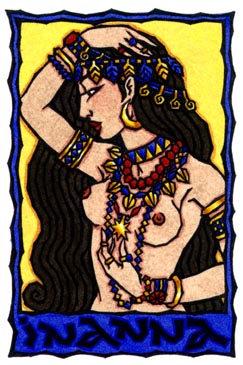
This week's card is Inanna, the Sumerian Goddess of Love and Fertility, Who is also the Goddess of the planet Venus as Morning and Evening Star. Her name means "Queen of Heaven," and She is the predecessor of the Akkadian/Babylonian
Ishtar. She was one of the most important Deities in the Sumerian pantheon, and She features quite heavily in known Sumerian literature.
Inanna is perhaps most famous for the story of Her descent to the Underworld. Inanna had a great deal of power and knowledge, and was familiar with both the heavens and the earth; but She did not have knowledge of the Underworld, and She knew this. So She resolves to go there.
But knowledge of the Underworld is hard-won, and at each of the seven gates Inanna is stripped of some of Her jewelry and clothes, symbols of Her status and achievements; and at last She arrives naked before Queen Ereshkigal.
Who promptly puts Her to death, and hangs Her body from a hook on the wall, like a piece of meat.
But up on the Earth Inanna's vital force is missed; and so the Wisdom-God, Enki, creates two beings to rescue Her from the Underworld. They go, and, by offering Ereshkigal compassion, convince Her to give up the body of Inanna, which they then bring back to life.
But no one had ever before left the Underworld, once there, and Inanna is told that in order for Her to be allowed to go back to the living world, She must find a substitute.
When She arrives back in the living world She is reunited with Her friends and family, who have mourned Her; and when the demons accompanying Her demand one of Them as substitute, She refuses, for They have been loyal to Her. But when She comes to Her husband, the shepherd-king Dumuzi, She finds Him quite unconcerned, blithely going about His business of the glory of being King. Enraged, Inanna selects Him, and the demons take Him away.
Inanna is shown here decked out in all Her jewelry, in a pose of seduction. Now when I originally painted this card I had meant it as a general comment on Her role as Love-Goddess; though now, after relating Her tale, I see the jewelry as those things, those achievements, She gave up at the Seven Gates.
When I first pulled this card last night my thought was that "seduction" was a very narrow, and very limiting, meaning, given that it implies She is performing for someone else and is being objectified. But then I thought,
No, She's looking in a mirror.Inanna is a
very sexual Goddess, one Who causes the life-force to flow throughout all of Nature; and Her sexuality belongs to no one but Herself. To quote one of my favorite passages, from
Inanna and the God of Wisdom, from Diane Wolkstein and Samuel Noah Kramer's
Inanna, Queen of Heaven and Earth:Inanna placed the shugurra, the crown of the steppe, on her head.
She went to the sheepfold, to the shepherd.
She leaned back against the apple tree.
When she leaned against the apple tree, her vulva was wondrous to behold.
Rejoicing at her wondrous vulva, the young woman Inanna applauded herself.
If we could all cultivate that level of honest self-love!
So I think that's the message this week for us all: to cultivate honest appreciation of our own beauty, power and sexuality and to approach the dark sides of ourselves with curiosity and a genuine thirst for knowledge, while appreciating our individual journeys as ways for us to grow. In this last week before Imbolc shows us that glimpse of the light at the end of the tunnel, as we are still inhabiting the darkness and quietude of deep winter (well, those of us in the North, anyway) we can take advantage of the opportunity to sit with our own darkness a little longer, and find the beauty and power within it.
So what does She have to say?
Look in the mirror and see Your own beauty. Look into that dark mirror, down in to the depths of yourself; see that great, great beauty, that goes back and back, down and down.
I am intimately, and I do mean intimately, acquainted with power. I take what is Mine, the wisdom, the adventure, the mourning and joy, all of it. I own Myself.
Love. Self-Love; I can't emphasize that enough. Look in the mirror, see yourself with great Love. This is an especially hard time of the year for some, when the newness has worn off, and when the resolutions start to fail. Remember Self-Love. You must love yourself first before you can effectively love others. And besides, it is simply the right way round.
What do you think?
To read more about Her, go
here. To read Ishtar's tale, which is very similar,
here.