Sunday, September 26, 2010

Goddess of the Week


The Hindu Goddess Uma is this week's pick; this is Her first time here. Well, sort of.

The thing with Hindu Goddesses is that they tend to slide into each other, especially given that reincarnation is a tenet of Hinduism; Sati, for example, Shiva's wife, is said to have been reincarnated in Parvati. Kali, Who came up both last week and two weeks before that, can be considered an aspect or even emanation (to use that word imprecisely) of Parvati, or Sati, or Durga (Herself sometimes an aspect of Parvati), and could even reasonably be said to be the same Goddess as Uma. It is assumed that a Goddess, or the Goddess, has been worshiped in India since prehistoric times; in medieval times a Goddess called Devi, 'Goddess' or Mahadevi, 'Great Goddess' was said to be the underlying principle behind all Goddesses, and ultimately no less than the very essence of reality. The Mahadevi is especially associated with this particular cluster of Goddesses—Parvati, Durga, Uma, Gauri, Kali, &c.

Now to Uma specifically. She is an aspect, or emanation, or independent Goddess Who was later attached to Parvati or Sati, Who personifies, represents or incarnates the practice of devotion and asceticism. She is closely tied with Shiva, the God of ascetics, and said to be His wife (Such is Her fame, however, that Shiva is often called 'Husband of Uma'). Her power derives from Her ability to practice austerities and in Her renunciation of the world; and in this form Shiva, Who is also the God of the phallus and eroticism, cannot deny Her.

Her name is said to come from Her mother's reaction when She learned of Her daughter's desire to become an ascetic: U! Ma! She cried—No! Don't!

A Goddess called Uma Haimavati is mentioned in the Kena-upanishad, which probably dates to the first or second century CE; the name Haimavati means 'She Who Belongs to Himavat', Himavat being the God of the Himalaya Mountains. Uma Haimavati is in later writings a name for Sati-Parvati, and indeed Parvati's name means 'Daughter of the Mountain', Her father also being Himavat or the Himalayas. Uma Haimavati is earlier than Parvati, though, Who is not mentioned by that name in the Vedic texts; She was perhaps attached to Parvati at a later date, or the early mention of Uma was assumed to refer to Parvati, perhaps to give Parvati a more ancient provenance.

Sati, Shiva's first wife, is sometimes called Uma in the stories when Her devotion to Shiva is being emphasized. However, when Sati's father insulted Shiva, such was Her devotion to Shiva that She killed Herself; and Shiva, Who hadn't cared about the insult at all, mourned Her death with such world-destroying intensity that the other Gods had to resort to a ruse to get Him to stop.

Parvati, as the later reincarnation of Sati, was destined from birth to be married to Shiva; but Shiva Himself, perhaps a little wary of marriage after that experience, did not want any part of it at first. So She withdrew from Him, and devoted Herself to a fierce type of asceticism.

Parvati as Uma surpassed even the greatest sages in all the traditional austerities, such as standing on one leg for years, living on leaves and air, and sitting between four fires at the height of summer. This type of practice is believed in Hinduism to generate tapas, a kind of inner heat or fire; this fire can get so hot in the great sages that the Gods fear for the safety of the world. This is turn means They are usually more than willing to grant the practitioner a boon.

Now Uma had focused Her devotion on Shiva; so, in time, it was He Who came to grant her dearest wish. That dearest wish? That she marry Shiva. And, having proved Herself not only His equal but His type, He readily agreed.

This week looks to be a continuation of the themes in play for the last three weeks, since Kali, also an aspect of Parvati, first came up. The problem is the same one that had you reaching into the darkness and the depths and the destruction; but the focus this week is on the work that must be done with it. It is hard work, but good work, and not something you can't handle, I don't think. Find that focus, and let your mind run on one track for a while. You will be able to achieve more than you thought was possible.

What does She say?

Practicing denial of the flesh so that one may unite with the Beloved? It has its twisted logic, doesn't it? But I know what I'm doing. And so does He.

And so do you.

Thursday, September 23, 2010

An Amused Question

A bit of levity, sorely needed I think with the great Kali showing up twice in three weeks.

Okay all you vision-havers and dream-interpreters out there, I got one for you.

What does it mean when one is entertaining a bit of a crush on a young Peter Gabriel, yet one is having recurring dreams of Phil Collins?

I can't figure out if I love or hate my brain.

Sunday, September 19, 2010

Goddess of the Week


This week's Goddess is Kali again, the Hindu Goddess of destruction and death, showing up for the second time in a month as the year tips towards the dark here in the north. The first time She was here was only the week before last; in between Her appearances we have had Sunna, the Germanic Sun Goddess. We have been taken to the black Void, then to the brightest Light, then back to the black Void. I do not know what is going on here.

Kali is the Goddess Who represents that which is outside of civilization and society, the messy reality of things which don't fit into the neat categories we create. She reminds us that those messy things are also necessary, sacred, and a part of the whole.

Though She is unquestionably destructive and horrific, as the primeval Void, She is also infinite potential. The waters of the underworld, where embryonic demons wait to be incarnated, are said to be Her womb, and indeed as I mentioned in the earlier post, Kali is revered in Tantrism as the shakti or primordial female principle, She Who underlies all reality, and Who is both formless and unmanifested, and manifested in infinite forms.

Maybe it's the time of year; after all at the equinoxes both hemispheres see day and night, the light and the dark in balance. This time of year is about just that, balance, not just the shifting seasons, in the growing or fading warmth, or the growth or death of the plants, but in the emphasis, the weight of things moving into another position. Autumn is here in the north, and summer has ended; and we must change ourselves to fit it.

Look this week to both your darkest dark and your brightest light. Find out how they are joined, and how they move in balance (for they are not static) to make a complete whole. Though you may not have to look very far; the 'energy' now feels pretty unsettled to me, and they may very well make themselves known all on their own. Try to take it in stride, I guess.

What does She say?


I am here, always here. I am the root and the dark; I am at the bottom of all things. And yet, go far enough down in the cold Earth and you will find heat and light, will you not? Within is without. You know this by now.

But look on the black side! Not all is blinding-brightness and burning heat. The dark can be very soothing, and offers healing and renewal in its own way. Things are waiting to be born in the lightless waters. Call them forth! Receive them! Be willing! For They will come anyway. And remember that when something is born, something else dies.

That is as it must be. Do not pretend to be surprised.


Well. What do you think?

Sunday, September 12, 2010

Goddess of the Week


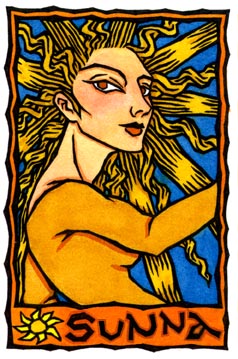
Sunna came up (ha) for the first time here just about two months ago, on July 5th. She is the Germanic Goddess of the Sun; Her Norse equivalent is named Sól. Both names just mean 'Sun.'

Sunna's sister is one Sinthgunt (Who may be a star Goddess, or a doubling of Sunna Herself), about Whom not a whole lot is known; in one of the so-called Merseburg Incantations, dating from the 9th or 10th century CE, both sing charms to cure Baldar's horse, which had become lame.

In Norse myth, Sól, the Sun, was created from the brightest ember that had escaped from Muspellsheim, the land of fire to the south. She was set in a chariot, drawn by two horses called Árvakr ('The Early-waking One') and Alsvin or Alsviðr ('The Fleet One'), which She drives across the sky every day, pursued by a wolf named Sköll ('Treachery'). She is said to be the wife of Glenr ('Opening in the Clouds').

An alternate myth says that Sól and Her brother Máni (the Moon), were originally the mortal children of a man named Mundilfäri ('Travels Like a Pendulum', perhaps an alternate name for the Moon), who were so radiantly beautiful that Mundilfäri named them for the heavenly lights. The Gods, however, were angered by Mundilfäri's hubris, and so snatched the children away, tasking them with driving the chariots of the Sun and Moon.

Sól is sometimes called Álfröðull, meaning 'Elf Disk', though this term is equally applied to Her chariot which holds the Sun.

I am glad to see Her after all the black of last week's Kali, I'll admit. Though I can't help but think the two are connected, as They are so markedly opposite. One week it's black as the Void and then the next it's the brightest of the Lights there are? Something's going on. I don't know if it's both/and or an either/or, though. The latter sounds like it could cause some serious whiplash. Take it gently, if that option resonates with you.

If the former, know that the digging in the dark from last week will allow you to stand more firmly, and be more grounded and rooted in the earth, which will form a stable base from which to reach towards the Sun.

Sunna is a healer, too; bask in Her warmth, and cultivate a sunny outlook if you can. It will help immensely at this time.

What does She say?

I am Healer, I am Light, I am the Sun, the Day-Star; I fly across the sky, regulating time, marking the day, and cutting the night up into manageable pieces, so there is never too much dark. Follow my example. Cut your darknesses up; make them into small things, and take them one night at a time. And do not despair. I am ever followed by the Wolf; yet, I do not let him catch me. Not yet, anyway. We will all be caught some day, it is true; in the mean-time, blaze forth in glory.

Monday, September 6, 2010

Goddess of the Week


Well, last week before I picked the card which would turn out to be Morgana, I thought for a moment, and tried to guess, or predict, Who it would be. And I came up with black, black black black. And I thought, Oh, Kali.

But it was Morgana, for whatever reason.

And now here Kali is. I guess I was off by a week.

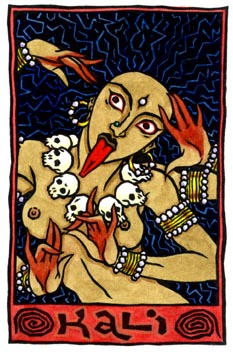
She is a Hindu Goddess of destruction, death, blood, disorder, and that which is outside of order and civilization. One meaning of Her name is 'The Black One', and She is always said to be black or dark. She was the first card I did, apparently out of nowhere, when I knew very little of Her, and before I had any idea that I would be doing an entire card deck of Goddesses; She should properly be much darker in Her skin tone. I apologize.

Kali is said to have been born of the wrath of a Goddess, either Durga, Parvati, or Sati, depending on the tale. As Their personified rage, She is so powerful and out of control in Her bloodlust that She threatens to destroy the world.

There are many tales of Kali involving Her frenzied behavior on the battlefield. Like Sekhmet of the Egyptians She is said to go into a battle fury and gleefully drink the blood of Her enemies, or anyone in Her way, really. Only Shiva, often Her husband, and no stranger to chaos Himself, has the power to calm Her, either by lying down in Her path and pretending to be a corpse, or by taking the form of a wailing baby. Either way, He attracts Kali's attention, and stirs Her compassion, so that She is calmed.

As Kali She is described as wild and dangerous, bloodthirsty and violent. She is depicted naked and emaciated, with fangs, claws, and a long lolling tongue; Her skirt is made of cut-off arms, Her necklace of skulls or severed heads, and Her earrings are the corpses of infants.

And yet.

In Tantrism, She is very highly venerated as the primordial shakti, the female creative principle. In the Mahanirvana-tantra, Shiva says:

Thou art Kali, the original form of all things... Resuming after Dissolution Thine own form, dark and formless, Thou alone remainest as One ineffable and inconceivable. Though having a form, yet art Thou formless; though Thyself without beginning, multiform by the power of Maya, Thou art the Beginning of all, Creatrix, Protectress, and Destructress.


And in the Nirvana-tantra, Kali is described in terms of the primeval ocean: She is like all the waters of the sea, and Shiva, Vishnu and Brahma are merely the water filling the hoofprint of a cow; and from Her those three arise like bubbles from the ocean's depths.

She is underlying reality, in all its mess, blood, disorder, and death. Yet She must be made peace with, and must be accepted, to be whole and to achieve salvation and enlightenment in Tantrism. She is a reminder that our desire for order goes against the nature of life itself.

So this week? Well, I won't lie. This is big stuff. Big ugly stuff, that is of necessity also truth. How well you are able to deal with it, face it down, accept and even love that ugliness will determine how well you do with it, and what you learn from it. There is powerful knowledge and wisdom here, remember.

Now. What does She say?

I am black. Black as the void, black as the all-swallowing Winter that approaches. Black as a hole, black as the heart of the Sun, black as the heart of you.

The Void is not nothing; that is the irony, the mystery at its heart. It is all potential, all material, all that is, waiting to be born, to be manifested. Yet until it is it is nothing. That is the mystery; that it is nothing, and everything, at the same time.

I am not that frightening. Or, well, maybe I am; but you will have to get over that. It is inevitable, you know, that you come back to Me. It is not something you can escape.

But take heart; you have come home to me many many times. This death is not your first. You are an old hand at dying, really.

And at any rate you do it all the time, don't you? For I am here now.


Reference:

Hindu Goddesses, by David R. Kinsley.

Sunday, August 29, 2010

Goddess of the Week


This week's pick is Morgana, also known as Morgan le Fay, the great sorceress and healer of the Arthurian legends. Though considered human in the late works, Morgana's divine origins are hinted at in her epithet 'le Fay,' meaning 'faery,' 'Fate,' or 'Otherworldly woman.' The strands going back are rather tangled, but she does seem to have a good part of her origins in an old Gaulish river-Goddess.

In the Arthurian legends, Morgan le Fay is one of three daughters of Gorlois, the Duke of Cornwall, and Ygraine, her elder sisters being Elaine (one of many in Arthuriana) and Morgawse, who would be mother of the infamous Mordred. They are half-sisters to Arthur, who was gotten on their mother by Uther Pendragon through a ruse (which makes it rape).

Morgan was unhappily married off to one Urien of Gore; their son was Ywain. She was very skilled in magic and much associated with Avalon, an Otherworldly island long connected with Glastonbury. She is usually thought of as a fierce enemy to Arthur; yet, when he was wounded at the end of his reign, she was one of the women of Avalon who took him in to be healed.

Those are the basics of the Arthurian legends. Let's look a little deeper now.

Her husband Urien (and their son Ywain) finds his origins in a real sixth-century king; his son Owain ap Urien was famous for battling the Angles. This fame got them both incorporated into legend, starting with the Welsh. Owain features in a tale of his own called The Lady of the Fountain; however in the Welsh Triads (Trioedd Ynys Prydain, Triads of the Isle of Britain), he is called a son of Urien and one Modron.

Modron is usually remembered as the mother of Mabon in the Welsh tale of Culhwch ac Olwen; he was said to have been taken from his mother when only three days old. Though there is not much information about either of them in this tale, there is something powerful and primal underneath it: for 'Mabon' simply means 'son', and 'Modron' simply means 'Mother.' Which means that Mabon ap Modron means 'Son, son of Mother', unusually enough; especially given that the ap part, meaning 'son of' is literally called a patronymic, meaning 'father-name,' it is remarkable that there is no mention at all of a father. And though he only has a bit part in the tales as handed down to us, yet Mabon gives his name to the collection of Welsh literature called the Mabinogion (or Mabinogi, more properly). Now Mabon does have Divine origins—ultimately he has his roots in Maponos, a Celtic God of Roman Britain often linked with Apollo. This is the Mother and Her Son.

Now as for Modron Herself: She in her turn derives from the Goddess Matrona, the eponymous Goddess of the Marne River in eastern France. Her name means 'Divine Mother'. She is probably a singular form of the old Matronae, 'The Mothers', Who are Celtic mother Goddesses going by a Latin name, usually shown in triple form, posed with various emblems of fertility such as bread, cornucopiae, or babies.

There is also a folk-tale that tells how Urien came upon a washerwoman at a ford; though she does not give her name, she tells him she is a daughter of Annwfn, i.e. a fairy-woman or Goddess, as Annwfn is the name of the Welsh Otherworld. She later has two children by Urien, Owain and a daughter Morfudd (mentioned as Morfydd in the Triads). And all that actually does connect Her with the great Irish triple Goddess of sex and battle known as the Mórrígan, which She is usually said not to have much relationship with, despite the similarity of names; for the Mórrígan can take the form of the Washer at the Ford, an Otherworldly woman seen washing bloody clothes in a river, Who presages the death of the person whose garments she washes.

You will notice, that even in the late legends Morgan is associated with triplicity—She is one of three daughters, a triplicity which is all the more pronounced given that Her sister Elaine has almost no story of her own; it's as if she is just filler brought into the stories to round out the number. And in the Vita Merlini (Life of Merlin) She is said to be one of nine sisters skilled in magic who live in Avalon.

So, then, what of all that?

It is remarkable to me how some things survive, and how despite layers and layers of camouflage and how various consonant, though unrelated stories can accumulate on an idea, one can still trace back to that source, that wellspring. In this case, literally, as Matrona has a shrine near to the source of the Marne River. I am tempted, then, to say that this week will be one of detective work and a search for origins; may it be as fruitful for you.

However Morgan le Fay, or Morgana, as I've called Her here, is perhaps calling us to remember our roots in a different way. She is never said to be anything other than human in the late tales; yet she still retains that 'le Fay' appellation. Work this week, I think, to discover your own fay-ness, if you will. We are not as separate from Nature as we would have it. We are certainly (and I realize I am rather preaching to the choir here) not un-magical beings, though we are human.

Her tale is of an ambiguous character, too; though Arthur's enemy she is also a great healer. Perhaps her story has merely been framed in a unflattering way by the storytellers who sided of course with Arthur; perhaps, also, it is a comment on the nature of magic being dark, complicated, many-sided, and rich, a characteristic that lovers of duality (who like to reduce everything to good and evil) cannot understand or endorse.

I think, though, that the main lesson this week is that you will have to figure it out for yourself. But this week marks the beginning of the end of summer, and the beginning of the turning of things, or at least that is what it has always felt like in my area. How is your world, your earth, changing now?

What does She say?

I am everywhere like the tide; the tide of the breath of the body, the tide of the seasons; I infuse it all. I am the undercurrent of the magical in all. I am that feeling of aliveness, that subtle body, the feeling of being alive. What is that after all but Magic?

Do not think that it is not all related, that the enlightenment of the Buddhists or the Christ does not also have its place, its name, its recognition in the older messier Ways; it is reality, after all, and it has always been, and has always been seen. Find the other definition for it, the one that is closer to home for you. It is there.


What do you think?

References:

The Dictionary of Celtic Mythology, by James MacKillop

Wikipedia, believe it or not, which proved handy for keeping things sorted out
.

Tuesday, August 24, 2010

Goddess of the Week


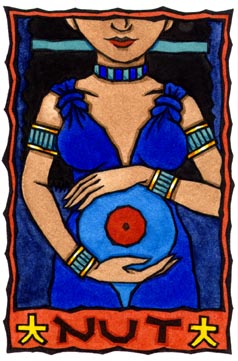
Nut is the ancient Egyptian Sky-Goddess; this is Her second appearance here, the first being last Valentine's Day (or Lupercalia Eve, if you prefer). She is one of the nine primeval Deities of the creation myths of Heliopolis. (Though the name Heliopolis is the one usually used, it is the Greek one; the old Egyptian name was Iunu Mehet or On. It is the modern Tell Hisn, a suburb of Cairo now). Several regions or cities in ancient Egypt had their own creation myths; in Iunu Mehet the story went like this:

In the beginning of days there was only Nun, the watery abyss, Whom the Egyptians called the 'eldest father'; out of Nun the Sun-God Atum emerged. Atum then created a mound of silt, which was the first land; after this He created two Deities, the Air-God Shu ('Dry'), and the Moisture-Goddess Tefnut ('Moisture'). From these two were then born another pair, Geb, the Earth God, and Nut, the Sky Goddess.

Geb and Nut then coupled, quite passionately.

In a slightly different strand of the myth, the Sun God Re (also of Heliopolis, and equated with Atum) then had Them forcibly separated by Their father Shu, the air, for He feared being overthrown by Their children. He further cursed Nut, and forbid Her from giving birth on any day of the year.

Luckily Thoth (Tehuti), the very clever God of Scribes, made a bet with the Moon and won, thereby gaining enough light to create five more days, bringing the total to 365 when it had been a nice even 360, or twelve months of thirty days each. (Of course 365 days is not the actual length of the year, it being more like 365.25 days, and they knew it; but the ancient Egyptians loved their round numbers and their order so much that, honestly, they kind of just let it slide). So Nut was able to give birth at last, and bore Osiris, Isis, Seth, Nephthys, and the elder Horus. Nut and Her five children, plus Geb, Tefnut and Shu, were considered the Heliopolitan Ennead ('group of nine Gods of Heliopolis').

Not counting Nun, apparently, and not naming the mound as the first bit of dry land, either, oddly enough.

As Sky Goddess Nut was said to swallow the Sun each night and give birth to it the next morning, making Her body, though the sky, in some ways a form of the Underworld; She was sometimes depicted as a sow, as they bear innumerable young (here equated with the stars) and have a reputation as cannibals who eat their young, as Nut alternately swallows the Sun (to bring night) and the stars (when it is day).

This week then is about waiting, pregnancy, and the anticipation of a good thing, I think, even if (like me) you have no desire ever ever ever to become literally pregnant yourself (or if, you know, you're a dude or something). Something Wonderful is coming—it is, in fact, just around the corner. The best part is that it's not something out of the blue, but something you have been working towards for some time that is about to bear luscious fruit.

Not, incidentally, that you need to do much about it at this point; it is, pretty much, inevitable that it comes at the appointed time. And that means whether you work at it or not at this point. Sure, keeping the momentum going is a good thing; but if you are tired or worn out, know that if you are unable to keep up your former pace now it will make little difference.

You may not even know you have been doing this work, incidentally. It may be one of those things that have been working themselves out on a deep dream-level, in your unconscious mind; perhaps something along the line of realizations about past circumstances that give you a new strength and purpose.

Just relax, and let it come, and be its own thing. Though like a child, it will almost certainly not be quite what you think it will be.

What does She say?

You are all my children. You are all born from me, as innumerable as the stars; and when your long day-life is over you will all come back to me, stars and gods and humans, devoured by the dark to be reborn sure as sunrise. Always devouring, always giving birth; it is the way of things, to be dark and light, joyous and fearful in their times. Though the fear is not really necessary, you know.

Granddaughter of the Void, they say; and I bear His nature, never forget.

Thursday, August 5, 2010

Off For A Bit

I'm about to go out of town for the next couple of weeks, which means that posting (and comment moderating) will be off until about mid-August. See you when I get back!

Sunday, August 1, 2010

Goddess of the Week


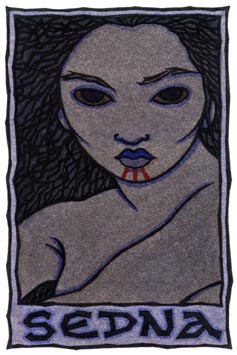
This is the first time Sedna, the Inuit Goddess of the Sea, has come up as Goddess of the Week. She lives at the bottom of the Sea in Her realm of Adlivun, the land of the dead, and She has control over all the animals of the Sea. She is the Inuit Great Goddess.

The Inuit, who live in the Arctic regions of North America, from Alaska to Greenland above the tree line, are popularly known as 'Eskimos'; however, this is generally considered a slur, as it means 'Foul eaters of raw meat' (a name given to them by the Algonquian Indians). 'Inuit' isn't quite right, either, as it's a little more narrow than 'Eskimo', but it is better, and I use it here. It derives from the word inua, meaning indwelling spirit.

Though most Great Goddesses are Earth Goddesses, Sedna is a Sea Goddess, which makes sense given the harsh climate that has forced the Inuit to turn to the Sea and its bounty to survive. As befits the Goddess of any Sea, but especially one so cold and harsh, Sedna is a mercurial, sometimes malevolent Goddess, Who can both give and withhold Her blessings.

The more well-known story of Sedna is from Greenland, where She is known as Nerrivik, a name which means 'Food-dish'. Nerrivik was once a lovely maiden who was reluctant to marry. She was finally persuaded by a handsome suitor; but when she went with him to his home she found she had been tricked, and he was a petrel-spirit in disguise. Her father and relatives found out, and rescued her; but on the way home the petrel-spirit raised a great storm which threatened to overturn their umiak (hunting canoe) and kill them all. In a panic and desperate to save himself, Sedna's father threw her overboard in an attempt to appease the petrel-spirit; but Sedna grabbed hold of the side of the umiak. Her father then took his axe and cut the ends of her fingers off. She still held on; he cut the rest of her fingers off. Still she held on, and he cut off her hands; unable to hold on anymore she then sank to the bottom of the Sea.

Her fingers and hands became the sea-animals, the seals, walruses, and whales; and Nerrivik became the Goddess of the Sea and ruler of the land of the dead.

A lesser-known story of Sedna is that She was the daughter of two giants and was born with an insatiable appetite. So insatiable and greedy was this appetite that Her parents were wakened one night to find their infant daughter attempting to eat them. Horrified at Her cannibalism, they took Her far out to Sea and threw Her overboard. Again, She clung to the side, and Her father mutilated Her, cutting off Her fingers, joints, and hands, which as above became the animals of the Sea.

When times are scarce, and the hunters cannot find any animals, the angakok or shaman of the people journeys to Her realm. This is a hard path, full of dangers, including an icy whirlpool and an abyss that can only be crossed on the edge of a knife, but if he or she makes it before Sedna, he or she then massages Her limbs and combs Her hair to soothe Her. If She is pleased, She can then be persuaded to tell the angakok one of two things: that She will send the animals, or that the angakok's people must move their settlement to another area.

She is also called Arnarkusuagsak ('Old Woman') and Nuliajoq.

The key, I think, in Her story is that though the environment is harsh and unforgiving, still, compassion plays a role. It is compassion that is given Her when the angakok combs Her tangled hair, as without hands She can no longer do it Herself. In some stories the angakok dances before Her, helping Her to forget Her harsh existence for a while.

Should you find yourself this week journeying to that dark cold realm inside you, remember to treat what you find there, the discarded, the hurt, the mutilated, with compassion.

Also, I think, have respect for those aspects of yourself, too. So often the metaphor is of going into the dark places and shining a light; this sounds in this case to be unnecessary, rude even, like suddenly shining a flashlight in someone else's eyes. Let your own eyes adjust in this case, and acclimate yourself to the dark. You will see more, and with more subtlety, if you do. Remember that though it is a part of you and you have the right to be there, that you are in some ways a guest, too. Do not just barge in and start demanding answers. Be respectful of what and who you find there.

What does She say?

She is the swell of the Sea, dark and huge; I can feel my body swaying, like you do after spending an afternoon swimming at the shore. She has dark eyes, like a seal, and does not smile.

You must understand, I did not give the animals freely. They were taken from me, and are mine, and I want them back, as I want the pieces hacked from me returned so that I may be made whole. You know this, you who discover truths; to live you must kill your brothers and sisters, the animals, the plants. You must kill me.

Though I endure. I am here at the bottom of the Sea, the cold, dark, icy Sea. Do you not think I have died? This realm is the realm of the Dead, is it not? How should I be here but that I am also dead, and that my injuries, my mutilation, have killed me? Does that not also mean that the animals who were my fingers, my joints, my hands, are all that is left of me alive?

You see why I do not let them go easily.


References:

Native American Myth and Legend: An A-Z of People and Places, by Mike Dixon-Kennedy

Recipe for Lughnasadh

No, it's not for sun-dried tomato herb bread, or little saffron rolls shaped like the Sun, but it does use the first of the tomatoes from my garden and some home-grown fresh sage.

Really I just threw this together this afternoon, but holy MOLY it was so delish that after I ate it I spent the next few hours desperately craving more and so found myself outside with a flashlight picking more sage. I'm eating it right now.

It's pretty simple, and goes together real fast.

Pasta with Browned Sage Butter, Tomatoes and Parmesan Cheese

And that's all the ingredients right in the title. Instructions are for one serving, since that's what I made but you can multiply as necessary.

Put pasta of your choice on to boil.

In a skillet, heat oh about 1/3 stick butter (three tablespoons or so, or more if you want; enough to act as sauce for your pasta) over lowish medium heat.

Wash, dry, then chop up about a dozen sage leaves, then throw them in the butter, where they will fry and become crispy. Keep an eye on it as it cooks, since you are trying to brown the butter, which can be tricky. It can take a while, which is a pain, but it's better to do it slowly than to burn it. The butter will get to a point where it's foamy; start watching then. The milk solids will start to precipitate out and turn brown, and the whole thing will smell nutty. You don't want it too brown, but it ought to be a little more than golden. You'll smell it. Take it off the heat when you think it's good.

In the meantime roughly chop a bunch of fresh, room temperature, never been in the fridge tomatoes. Throw them into the butter when you take it off the heat to warm up a little.

Grate a decent sized pile of parmesan (I used the smallest holes on the grater, so my pile was pretty fluffy), then, drain the pasta, throw it in a bowl, pour the butter/sage/tomato sauce on top, then the cheese. Mix it all up and eat!

Sunday, July 25, 2010

Goddess of the Week


Al-Uzza is the Arabian Goddess of the planet Venus as the morning star from the time before Islam. Her name means 'the Mightiest One' and She was one of the main Goddesses of the Nabateans, an Arab people who lived in the area of Jordan and northern Arabia from about the 4th century BCE to the 3rd century CE. Their capital was the rock-cut city of Petra in Jordan; al-Uzza was likely the patron Goddess of that city.

She has come up twice before here as Goddess of the Week; once in January 2009 and again in December of the same year.

It is a little hard to be definite about al-Uzza; the evidence is distant and confusing, and there is a fair amount of disagreement even among the experts.

In Islamic sources (i.e. late sources), the Goddesses al-Uzza, Allat ('the Goddess' or perhaps 'High One') and Manat (probably 'Fate') are considered separate sister Goddesses, with Manat the eldest, Allat the middle sister, and al-Uzza the youngest (or the one Whose worship was the youngest). They are even called the daughters of Allah, and in fact there was a famously redacted Sura in the Koran speaking of Them, the so-called 'Satanic Verses'. (Even Islam found it difficult to completely eradicate the underlying Pagan beliefs of the earlier culture.)

In early Islamic times al-Uzza was the main Goddess of the Quraysh tribe, from the area north of Mecca, while Allat was worshipped by the Thaqif tribe from Ta'if, about 60 miles southeast of Mecca. All three were said to have 'idols' in the Ka'aba at Mecca, that mysterious cube at the center (literally) of Islamic worship. The Ka'aba was already a major center of pilgrimage before Islam, and was apparently a Pagan temple or shrine, as it was said to house 360 'idols', which Mohammed had cast out and destroyed. The Quraysh, in particular, were said to invoke all three Goddesses as they circumambulated the Ka'aba.

It should be noted that the forms above are the Islamic versions of the names; the Nabatean versions are al-Uzza, Allatu, and Manotu (or Manawatu).

The Greeks of the time identified al-Uzza with their Aphrodite Ourania, Heavenly Aphrodite, presumably because She was a Goddess of the planet Venus, and Allat with Athena (I have no idea why). Al-Uzza, at least in Petra, also seems to have been associated with, or at least shared some iconography with both Isis, the Egyptian Great Goddess, and the Greek Tykhe, Who started out the Goddess of Fortune, but Who later took on a role as the guardian spirit of cities.

Allat and al-Uzza in a lot of ways blur into each other, and it may be that al-Uzza was originally a title of the Goddess Allat, Who splintered off into a distinct Goddess. Some scholars believe that al-Uzza was the main Goddess of the Nabateans, though She was known throughout Arabia, as a Sabaic (southern Arabia, modern Yemen) form of Her name is Uzzayan.

A late fragment of poetry mentions al-Uzza and Her 'two daughters'. There is debate as to Who Her consort was; perhaps it was Dushura, the mountain God, and Her two daughters may be Allat and Manat.

In Petra there are numerous dedications to al-Uzza (and none to Allat); the so-called 'eye idols' are assumed to represent Her.

She is sometimes called a warrior Goddess, though I'm not sure now where that comes from; perhaps it is by comparison with Ishtar, also a Goddess of the planet Venus, as well as the meaning of al-Uzza's name, 'the Mightiest One' which does sound appropriate to a bellatrix, it's true. But I haven't found anything that supports it in the more scholarly sources (as opposed to the more popular sources) and that's one reason I redid the artwork last year.

This week both grounding and growth are needed. Remember that a tree cannot grow tall without the support of its roots, and that the depth and size of the root system of a tree mirrors the height and size of its trunk and branches. There is just as much below the surface as above. As below, so above, in this case. Thinking about things in that order will I think make sense of your current circumstances.

So, keep your feet firmly planted on the earth, but look to that star shining above you. Take your cue and inspiration from its rhythms, as well as the rhythms of the earth. It is a curious sort of balance called for this week, I think.

What does She say?

I am the Stone, the solid, the square, the haunted djinn-block. The sands shift around me but I may not be moved. I am that which is constant and unmoving.

And I am the Star, the bright, the shining, the distant one. I wander through the heavens to either side of the Sun. I am that which is constant and moving.

I support and I shine. Look to Me in both these places, in the Stone beneath your feet and the Star high above. And remember I am the Mighty One. Call on Me!


What do you think?


References:

The Religion of the Nabataeans: a Conspectus by John F. Healey. Accessed through Google Books, alas. Imperfect, I know. But the damned thing is a $200 book!

Also, again, The Book of Idols, by Hisham ibn al-Kalbi. Again, warning on that site; though this part is just a straight-up translation without commentary of the original book, the site itself is some Christian propaganda anti-Islam site. The only other on-line version I could find of The Book of Idols had no paragraph breaks and crashed my browser.

Tuesday, July 20, 2010

Goddess of the Week


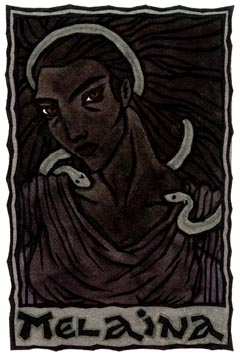
Melaina is a dark, angry aspect of the ancient Greek Earth Mother Demeter, which She took upon Herself in response to a time of great pain. She has come up once before, in November of 2008, the beginning of the dark time of year here in the north.

One of the most well-known myths of Demeter involves Her beloved daughter Kore, Who was abducted and raped by the Underworld God Haides when just a girl, vanishing without a trace into His realm under the Earth.

When Demeter found Her daughter suddenly gone, She dropped all Her duties as Earth Mother and began the long search for Her, wandering the earth in frantic grief. But She received little help; for Kore had been abducted with the tacit approval of Zeus, and few wanted to cross Him.

In the midst of this dark time, the Sea-God Poseidon conceived a lust for Demeter. When, unsurprisingly, She was in no mood, He pursued Her; and though She tried to escape from Him by taking the form of a mare and running with the wild horses of Arkadia, Poseidon soon enough found Her, and in the form of a stallion He raped Her.

This was simply too much for Demeter, on top of everything else She was going through, so She clothed Herself in black and shut Herself up in a cave in Mount Eliaos, near to the town of Philagia. From the rape She bore two children: the immortal horse Areion or Arion, Who could speak like a human, and a daughter, Whose name has not come down to us. Not, for once, because She was unimportant, but because She was considered a most holy maiden, and Her name was secret, given only to initiates into Her mysteries. They have kept that secret, and Her true name is not known. Her title, however, has survived: Despoena, the Mistress.

Demeter was eventually coaxed out of the cave by the Moirai, the Fates; They are said to have persuaded Her with Their words, perhaps reminding Her that while She was in hiding, and while Her powers of fertility were withdrawn, the crops of the world (and so the people of the world) were dying. That is the usual story, anyway; I am more inclined to think the Moirai did not persuade Demeter with talking, but by listening to Her.

This is a very dark and violent tale; and I suspect it has been quite twisted in a particularly patriarchal way. But this time the casualty is not just the Goddess, but the God as well, Poseidon. There is evidence that He and Demeter may have formed a cult pair in early times; Their names are mentioned together in Mycenaean Linear B tablets from Pylos, Their names written in that syllabic script as Da-ma-te and Po-se-da-wo-ne. Poseidon's name means 'Husband of Earth' or 'Consort of Earth', and even in classical times He was remembered for His connection with the Earth, as the 'Earth-shaker', Ennosigaios, the God Who brings earthquakes. I suspect Their relationship was in earlier times rather less antagonistic.

The Phigalians accounted that cave sacred to Her, calling Her Demeter Melaina, 'the Black', supposedly after the black clothes She wore; and they set up a wooden statue, described by Pausanias in the 2nd century CE thus:

The image, they say, was made after this fashion. It was seated on a rock, like to a woman in all respects save the head. She had the head and hair of a horse, and there grew out of her head images of serpents and other beasts. Her tunic reached right to her feet; on one of her hands was a dolphin, on the other a dove.


Melaina is Demeter in Her chthonic aspect, literally meaning of the Earth. She appears dark and monstrous, but it should be remembered that the serpents and horses may simply be symbolic of the earth.

Go into the dark a little this week. It may be that it is time to bring a traumatic or difficult aspect of your past to the light, where it may be healed; conversely, it may instead be a time to shut yourself off from the world. It is hard to tell, and can go either way; be gentle and compassionate with yourself, and do not do anything if you are unwilling, or if you are not truly ready. You will know. If you are unsure, don't.

The dark is, as it ever is, not nearly as frightening as your fears make it out to be; keep that in mind, also. Also keep in mind that acknowledging something is as good as accepting it in a lot of ways. It needn't be that difficult. You might be surprised.

As ever, I ask Her what She would like to say.

Darkness, it is all darkness. But of your own choosing; your anger, your pain, your hiding, your hibernation away from the light, your rest, your time of healing. Sometimes shutting yourself away from the world is necessary. Sometimes, even, stewing in your own anger is necessary. Do not be afraid of the dark, in all its manifestations. It is an aspect of Me, always.

Tuesday, July 13, 2010

Comment Moderation Enabled

'Cause I'm sick to death of the ?? spammer comments.

To the asshole who keeps spamming my blog comments:

This means that no one but me will ever see your comments. You may as well not waste your time, correct?

Also, may you get what you deserve, thrice over.

Monday, July 12, 2010

Goddess of the Week


Idun, the Norse Goddess of springtime, renewal, and eternal youth, makes Her third appearance here as Goddess of the Week; though She is Goddess of spring, She keeps showing up in summertime, Her first appearance being June 29 of 2009, and Her second on August 24th of the same year. She is said to grow the apples that keep the Deities young, which She keeps safe, giving them out when needed.

Idun is the daughter of Ivald, one of the Dökkálfar ('dark elves') or Svartálfar ('black elves'); they were generally considered to be the same as, or generally confused with, the dwarves, though if you're a Tolkien fan that may seem incomprehensible; in Norse myth the Dökkálfar/Svartálfar/dwarves were said to have been born from the maggots that fed on the corpse of the primeval giant Ymir, out of Whom the world was created. They are called 'black' or 'dark' both because they did not like the light, and because they were thought spiritually unenlightened; in myth, daylight turned them to stone, so during the day they dwelled underground.

Idun is mentioned in stanzas six and seven of the Hrafnagaldr Óðins, or The Incantation of Odin's Ravens, a late Icelandic poem:

In the dales dwells
the prescient Dís,
from Yggdrasil’s
ash sunk down,
of alfen race,
Idun by name,
the youngest of Ivaldi’s
elder children.

She ill brooked
her descent,
under the hoar tree’s
trunk confined.
She wuld not happy be
with Nörvi’s daughter,
accustomed to a pleasanter
abode at home.


I could find no mention of Idun's mother, but She must not have shared Her father's (and brothers') intolerance of the sunlight, for not only is she said to have lived in the dales or valleys, but 'Nörvi's daughter' refers to Nott, the Goddess of Night.

She is called above a Dís, usually translated as 'lady' or 'Goddess'; the Dísir as a class are a bit difficult to pin down, but are female Deities or spirits Who may have roots in the dead, or in Goddesses of the earth; Freyja was called Vanadís, or 'Dís of the Vanir' in Her role as fertility Goddess.

The Hrafnagaldr Óðins tends to baffle scholars, who can't even agree on an approximate date; it may describe Ragnarok and the ending of the world. The stanzas about Idun above seem to refer to an unwilling descent into the earth at that time, one She had foreseen; as She is the Goddess of springtime and youth, this may refer both to the ending of the Deities' lives, and the coming of the Fimbulvetr, the three-year-long winter that will usher in Ragnarok.

Despite Her family's unenlightened origins, Idun was considered a major Goddess; She married the God Bragi, son of Odin and the giantess Gunnlod, and had a place at the feast table in Ásgarðr. She was well-loved by most of the other Gods (though Loki lit into Her once without cause), though one wonders how much that had to do with the fact that She held the apples that guaranteed Their eternal youth.

I wonder. Her name means 'the Ever-Young' or 'She Who Rejuvenates'; how much of Her is based in an Earth-Goddess (for want of a more precise term)? She is a daughter of the earth-dwelling Dökkálfar, She tends to and harvests the apples of youth Herself, and there is a story of Her descent into the earth at the root of Yggdrasil. The Earth of springtime might certainly be called She Who Rejuvenates; and spring itself, though young each year, is ever-ancient in its cycle.

So what does that mean for this week? Though it is summer (or winter in the south), look to a current cycle; something is in a springtime phase, now, one of renewal and rebirth. But a gentle kind, less a painful sloughing of skin like a snake, and more the refreshment of a good night's sleep. Look also to the echoes of past cycles in this one. For example, I was quite surprised to find, in comparing journal entries over a year or two, that the same very specific mood (down to a liking of moody black and white photos!) would come up at the same week from one year to another. Now is a good time to see the similarities across the years; see what you can find. It will help make sense of what is happening now.

What does She say?

Be renewed. I am the Goddess of stem cells, that heal, renew, repair. I am rejuvenation; I am hoarded health. You may call on it now, that which you have kept saved. You are stronger than you think. Tap into it now, if you need it.

All is well. The new grows from the old; the new destroys the old as it grows. Health destroys disease as it grows. All is well.

There is always the new. Never fear.


What do you think?


References:

An Introduction to Viking Mythology, by John Grant;

bit of Wikipedia, again, though it was significantly less helpful this time;

and the Benjamin Thorpe translation of the Hrafnagaldr Óðins accessed at Northvegr

Monday, July 5, 2010

Goddess of the Week


This is the first time the Germanic Sun Goddess Sunna has come up; appropriately enough up here in the north the summer is just getting started. The sun is high and what is usually the hottest month of the year has begun.

Sunna is the personified sun in Germanic myth, and Her name, as you may have guessed, means 'Sun'; She is said to be the sister of the Goddess Sinthgunt, about Whom not a whole lot is known, though She may be either a Moon or Star Goddess (the former being problematic as the Moon was generally thought to be male in the Germanic/Norse system). Both of them are mentioned in the Merseburg Incantations, medieval German magic spells from the ninth or tenth centuries; in them the sisters, with Frija, Volla, and Wodan (Freja, probably Fulla, and Odin) cure the horse of Phol (possibly Baldr), which had sprained its foot. So Sunna, then, was at least thought to be skilled in magic, and to have healing powers.

In closely related Norse mythology, the Sun Goddess is called Sól, which also means 'Sun'. Here is Her tale:

At the very beginning of things was Ginnungagap, the Abyss; it held at once everything and nothing. Out of the void came Yggdrasil, the World Tree; self-created, it would run through the center of all the nine worlds.

At Yggdrasil's southernmost root was Múspellheimr, a land of heat and fire, from which embers constantly drifted; these embers in turn melted the ice of Ginnungagap, and the quickened steam and water became the first of the frost giants, Ymir. At the same time a cow, Audhumla, was created; She fed Ymir with Her milk, and licked at the salty blocks of ice, within which was another creature, Buri, the ancestor of the Gods. After three days licking Buri was wholly freed of ice; but in this time the sleeping Ymir had created both the first humans (in this version, anyway) and a six-headed son named Þrúðgelmir, Who then 'gave birth' to Bergelmir, the ancestor of the frost giants.

Buri also had been busy, and had had a son, Börr; the two lines, then, frost giants and proto-Gods set themselves at war, as is perhaps inevitable in Norse mythology. The war lasted for the usual mythical aeons, but then a giantess named Bestla married Börr and by Him had three sons: Odin, Vili, and Ve. With Their help Ymir was killed; and from Ymir's body Odin, Vili, and Ve created our world, Midgard, the world of mortals. And, and this is where this all becomes relevant, from the brightest of the embers of Múspellheimr, They created Máni, the Moon, and Sól, the Sun.

Máni and Sól were then charged with driving the Moon and Sun across the heavens in chariots. Sól's chariot is drawn by two horses called Árvakr ('Early Awake') and Alsviðr ('Very Quick'), but like Her brother She is pursued by a wolf; at times he nearly catches up with Her, which is said to cause eclipses. It is foretold (or has already come to pass) that at Ragnarok the wolves will catch up with Them and destroy the Moon and the Sun.

I will note that as is annoyingly usual in some patriarchal creation myths, the female element has in large part been disappeared. Þrúðgelmir, after all, cannot 'give birth' alone, can He? And if 'He' did then by definition He's a She, isn't S/He? I know, pesky logic. The Norse myths were written down for the most part fairly late, at least a couple centuries after the lands had already been Christianized; like Welsh myth, it can be hard to discern the underlying layers (and I am no expert in Norse myth, trust me). So I don't know if there is something more under there. It is, certainly, a heavily Indo-European tradition, which makes it especially remarkable that the Sun is coded as female and the Moon male. At any rate.

I very much want to interpret this card as a positive sign, of rising fortunes and brighter times this week; but I keep coming back to the fact that this is Norse myth, where the warmth never lasts and all the world begins and ends in ice. However, I suppose, though the summer in the high north is not as warm as it is further south, the Sun is out for far longer in the summer days; this year on the solstice in Stockholm, Sweden, the sun rose at 3:31am and set at 10:09pm, making the day more than eighteen and a half hours long. Perhaps then, this is more about light than heat. What is being illuminated now? What can you get a good, long, look at now?

What does She say?

I draw the darkness after me. This is not frightening, or terrible; it is just night, and night is normal and natural. You need not fear if the light does not last. For though it may not seem it I always come again. Sure as sunrise, don't they say?

Enjoy me while you can. This also, is not terrible, nor a threat; simply a reminder to appreciate what you have while you have it. Your day in the sun is now. Live it, enjoy it, bask in it. Let yourself be warmed.


What do you think?


References:

An Introduction to Viking Mythology, by John Grant;

and surprisingly enough, Wikipedia is pretty thorough on Norse myth.