Monday, November 9, 2009

Goddess of the Week


This is the first time Oshun has come up; She is originally an Orisha (Spirit or Goddess) of the Yorùbá people, who are mostly from the West African country of Nigeria (though more than a million live in Benin, also). She is the Deity of the Osun river in Nigeria (where Her name is usually spelled the same way, Osun), and like Yemaya, finds a place in many of the 'New World' religions of the African diaspora, such as Lukumi (aka Santería), where She is known as Oshun or Ochun, and Brazilian Candomblé, where She is Oxum.

She is a Deity of love and beauty who is also concerned with matters of riches and prosperity and abundance, as well as prediction and divination; the eldest of the Orishas, Obatala, taught Her the proper use of the cowrie shells, which knowledge She then passed on to humankind. She is charming, and beautiful, and on the young side, being a bit of a coquette, so I hear; and gold, orange, and yellow are Her colors, the colors of wealth, the muddy river, pumpkin seeds. Five is Her number.

She is called Oshun Yeye Kari, "the Mother of Sweetness," and sweet things like honey, oranges and perfume are offered to Her; as is the pumpkin, both for its orange color and the abundance of its seeds.

She is about both sweetness and healing; and She has a bit in common, it occurs to me, with Kamrusepas, that Goddess of the Hittites Who heals with honey and fruit and sweetness.

When I first picked this card it struck me as personally rather incongruous, because I would not say I feel life is very sweet right now; in fact much of my personal work lately has been about acknowledging and accepting a great deal of anger on my part. And then I thought about how my surroundings aren't exactly infused with sweetness at the present time either, and, well, I got a bit cynical, which is never good for helping one feel sweet.

And though of course these readings are not really for my benefit, it takes a bit to see through one's own filters, as ever; and so the question that came to me was how does one find sweetness when it is not around you? If your environment isn't sweet, then what?

The answer as always is to look within yourself. If they can't provide you with it, you can at least give it to yourself. You have to start there anyway.

So, this week, look to how you can be kinder, sweeter, to yourself, regardless of how bitter your circumstances might feel, and without discounting or invalidating your own anger or bitter feelings. It's not that dealing with anger is not important work, if that is where you are; rather that a break is much needed and can help you get perspective. Perhaps it might be good to put it down, for a little while.

This week think about how you treat yourself. Honey, we call our sweethearts--what if we took a week and used that name on ourselves? What difference would that make in how we looked at our actions, our thoughts, and how we treat ourselves? How can you treat yourself with sweetness?

I ask Oshun if She has anything to say to us, and She says:

Flow flow flow, slow and smooth, like gold, sweet sweet honey, sweet sweet water; let it all flow. Just let it, no pushing; it will find the way. Water always does. Let it carve out the path of least resistance and greatest beauty, the sweet sweet waters. Flow, flow, flow. Just let it be. It will find its way. You will find your way. Down, down, downhill to the Sea. All is well. All is golden and lush and sweet. See your face reflected in the setting sun, down, down, sunset reflected in the blue Sea. Let it be.

Monday, November 2, 2009

Goddess of the Week


Apparently we are on Southern Hemisphere time this week, since this week's Goddess is Gwenhwyfar, Who I've depicted here as the quintessential May Queen (and yes I've spelled it wrong on the card). But it is a little odd to be looking at Her up here in New England, since we are now in the starting days of grey miserable yucky November (can you tell it is my least favorite month?) and are still in the season of Samhain, of death, decay, and the thinning veil.

However Samhain and Beltaine have more in common than one might think. The veil is thin at both times, though Samhain favors ghosts and the dead while at Beltaine it's more likely to be the faeries coming through. Not too surprising, really, when you consider that even though from one location the holidays are at opposite ends of the year, from the Earth's point of view they happen at the same time.

Gwenhwyfar last came up both the first and second weeks of May, at what would seem a far more appropriate time, given Her connection with the idea of the sacred marriage. Called Guinevere in the Arthurian legends, she is the wife of the great King Arthur, and famous for having an illicit affair with the best of his knights, Lancelot du Lac. ("Du Lac", incidentally, meaning "of the Lake" because he was brought up by the otherworldy Lady of the Lake, Vivian.) Her origins have mostly been forgotten but may well lie in an old sovereignty Goddess Who embodied the land; and there are hints of a Divine origin for Gwenhwyfar, here and there.

And I know all this, and you do too if you've clicked on the links above; but I was still having an impossible time figuring out why She might show up now when Samhain is just so strong up here, aside from the lesson to remember that opposites contain the other (Samhain/Beltaine), or that the northern hemisphere isn't the only one the globe possesses.

Then I remembered Her name.

Gwenhwyfar means "White Phantom."

And I think of those other Celtic sovereignty Goddesses, like Epona, and Rhiannon, and even Blodeuwedd, Who embody the land; and each of Them has Their winter, Their dark, chthonic side: Epona is held to be a psychopomp, a Soul Guide Who brings the newly dead to the Otherworld; Rhiannon's first husband, Pwyll, was the King of that land for a time; and Blodeuwedd, though made from spring flowers, has as Her emblem the owl, that lonely haunter of the night.

And what is under there, then? It is hard to tell. Gwenhwyfar's, Guinevere's, story as we know it now has been so thoroughly interwoven with a later set of rules it is hard to know which threads to pick; I had never understood, for example, why, once Arthur was killed, Guinevere never married Lancelot, and instead chose to become a nun; I had thought that it was some kind of strange strict Christian morality play (which it may well be), but now I see that given the underlying logic of things she cannot marry Lancelot. For if she does, he becomes King. And the story, being that of greatness and glory irretrievably lost, is such that it must end.

Perhaps that is the thread. When Arthur first meets Guinevere, Merlin warns him against the marriage; and indeed the Queen is often indirectly (or directly) blamed for the fall of Camelot because of her affair with Lancelot.

I can see her flickering at the corner of my vision, now, stopped in a doorway to glance at me, before She is gone. She is all in white. This time is a threshold, is it not?

So I ask the Goddess as always, What do You have to say?

White am I, like hawthorn, like snow. I am white, white as ever I am, as white as apple blossom as white as bone, both, as I always am and always have been. As I am ever I, all of me, the White Lady, the Great Queen, the bone-white Mother, the white shadow of the land. I am all these things, these are all myself, one I, the horse carved in the chalk, winter's water overrunning summer's settlement, the white at the heart of the dark, the white you cannot see, the bone hidden within the flesh and the body that does not see the light of day whilst one lives. Except in bared teeth, that is, and that is a clue to my nature; it is the white smile of a gentle lady, and the knowing grin of the skull. This is nothing new; I am surprised you have not learnt it by now.

Remember both. Like Samhain and Beltaine happen at once, I am at once both, and so thoroughly both it is only one thing. My left hand and my right hand, identical and perfect and mirrored. If you look now you will see them both.

Friday, October 30, 2009

Remembering the Ancestors at Samhain


I actually have an ancestor who was burnt at the stake. This fact is very impressive in certain Witchy circles; though he wasn't burnt as a Witch, just a heretic. Just. Like that made a difference.

So at Samhain, and though my religion is not his religion, I remember John Rogers, Protestant martyr, who was burnt at the stake on February 4th, 1555, in the town square in Smithfield, England. He has more than a few descendants, I hear; and no wonder, considering he had eleven children, one famously 'a babe at the breast' when he was executed.

He had a hand in translating into English what would become the King James version of the Bible; there is a Wikipedia page on him if you are so inclined.

His spirit of non-conformity, in both the usual sense and its original, religious, sense, lives on, and is in fact quite celebrated on that side of my family, the crazy artsy side, my mother's side. We remember him in how we live.

This also means the urge to religious freedom is in my bones.

So at Samhain, Summer's End, I remember John Rogers.

The Veil

It's odd. This time last year I could feel the veil thinning so profoundly that I feared it would tear. This year I can't tell at all.

Okay, it's not that odd.

See, I live in an old house. A very old house, for this area at any rate; one that's a good two hundred and fifty years old, an old New England colonial, the kind with the enormous central chimney and a fireplace in every room. Now, it's a lovely quaint house, with the clapboards and twelve over twelve windows, don't get me wrong, but it comes with a bit of, shall we say, baggage.

And I grew up here. I spent some time away from it, and have come back to it since; but I was a child in this house. Which is its own kind of baggage, I know.

Besides being my childhood home, it was also the childhood home of a certain murderer, now, thankfully, deceased, who was a child living here in the fifties; my father, in fact, bought the house from his mother. There are tales of plastering over bullet holes in one of the attic rooms where he supposedly had taken pot shots at flies with his BB gun.

Now, all that might sound like a delightfully thrilling little bit of history, something to spook kids sitting around a campfire at night. Yeah, well, except it's true.

And except for the fact that I am a person given to anxiety, and have been so all my life. I have never, unsurprisingly, understood that idea about kids liking to be scared; for me, that is something dearly to be avoided. I am still, at forty years old, afraid of the dark.

And besides the murderer who lived here, this house is, like I said, two and a half centuries old. I once told my best friend that I was afraid of ghosts, and she said, 'Well, yeah,' (actually, the way she said it it was more a 'well, duh') 'you live in a haunted house.' And that will make me feel better how exactly? Thanks, Tracey.

And there I was last year, or here I was last year, in this house, ultra-sensitive to the thinning veils around me. I was seeing things out of the corner of my eye all the time. I would come down into the kitchen to find my mother just leaving the room, only it wasn't her, and there was no one down there; or it would slowly come to me that there was a man standing over there in the piano room; or I would get up in the middle of the night and nearly trip over a cat who wasn't there; never mind finding Emily, curious, bent over me watching me while I was sleeping. Jesus Christ; for a nervous and naturally anxious sort, these things were just not good for me.

So I shut it off. Literally; I imagined a wall, on which was a series of outdoor taps, like the kind you attach a garden hose to. And I went up to the one labelled 'ghosts', and I shut it off. Completely. Not even a drip. And, periodically, over the course of the last year, I have checked on it, to make sure it is still off. Off, and quite dry.

And I have to say this last year I've been much better on the anxiety front. So much, in fact, that this year I found myself actually enjoying autumn, the colors of the trees and the crisp air and all, which, unlike pretty much every other Pagan in the entire world, has always been one of my least favorite seasons. And I also find myself very much into Hallowe'en, and (and this is very much an artist thing) craving the color scheme of black, ash grey, pumpkin orange, and electric midnight blue. It's kind of funny, actually.

I am relaxed and free.

But I can't feel the veil thinning at all. It is like I have cotton in my ears.

It is not ideal, no, and I know this; but, still, for now, I will take it.

Monday, October 26, 2009

Goddess of the Week


Lilith, Whose name means "Night Spirit," is a Sumerian dark Goddess Who is linked with the great Goddess Inanna. She may have Her origins in a type of night or wind demon; and in the Sumerian tale of The Huluppu-Tree, dating to at least the mid-third millenium BCE, Lilith represents Inanna's fears:

At that time, a tree, a single tree, a huluppu-tree
Was planted by the banks of the Euphrates.
The tree was nurtured by the waters of the Euphrates.
The whirling South Wind arose, pulling at its roots
And ripping at its branches
Until the waters of the Euphrates carried it away.

A woman who walked in fear of the word of the Sky God, An,
Who walked in fear of the word of the Air God, Enlil,
Plucked the tree from the river and spoke:
"I shall bring this tree to Uruk.
I shall plant this tree in my holy garden."

Inanna cared for the tree with her hand.
She settled the earth around the tree with her foot.
She wondered:
"How long will it be until I have a shining throne to sit upon?
How long will it be until I have a shining bed to lie upon?"

The years passed; five years, then ten years.
The tree grew thick,
But its bark did not split.

Then a serpent who could not be charmed
Made its nest in the roots of the huluppu-tree.
The Anzu-bird set his young in the branches of the tree.
And the dark maid Lilith built her home in the trunk.

The young woman who loved to laugh wept.
How Inanna wept!
(Yet they would not leave her tree.)


Here Lilith is a stand-in for Inanna's fear of Her own power and sexuality, represented by the throne and the bed She wishes to build for Herself. But Inanna is too afraid to face Her fears alone. She first goes to Her brother Utu, the Sun God, Who refuses to help Her. But Gilgamesh, the famous hero, will, and does so by striking the snake at the roots and chasing the Anzu-bird away. Lilith also then leaves the tree; however, She, it is said,

...smashed her home and fled to the wild, uninhabited places.


In other words, though Lilith flees, She gets a shot in first. Lilith always does things on Her own terms.

After this, Inanna gets Her throne and Her bed, and is able to claim Her power.

A little of Lilith's legend bled over into the local monotheistic traditions, and so She found a place in Jewish legend as the first wife of Adam, created like him from clay. When She rejected Adam because he insisted that he was superior, She uttered the sacred name of God and left Eden, to give birth to demon children in sadness. She was regarded as a dweller in desolate places, and commonly believed to be a succubus, causing lust and nocturnal emissions in men.

Now, of course, I'm a Pagan, so inclined to regard that last talent with kind of an Eh? So what? but apparently it has caused some distress over the years among the monotheists. Poor things.

At any rate, it does speak to Lilith's sexual power and ability to cause fear. I'm not surprised, really, that Lilith is showing up this week, the week of Samhain here in the north (or for that matter, odd as it sounds, for Beltaine in the south, given that holiday's association with lust), the week that ushers in the dark half of the year.

Lilith is the fear that keeps us from beginning, and keeps us from acting. Standing here at the threshold of the dark at Samhain, I am not surprised that fear is coming up. What lies ahead of us now is the dark, and we will not be able to see there. I do not know what the solution is, whether to chase Her out with brute force, as in Inanna's legend (though if you do expect that She will not like it, and will destroy something on Her way out), or whether one can go into the desolate places, Her land and home, and seek Her beauty and strength there. Lilith is strong and righteous in Her own way, after all. In the Jewish legends, She had such obvious respect for Her own self worth that She chose to flip off God and be alone rather than live in Paradise as an inferior.

I suspect that Lilith will prove a friend to bold women.

And as always, I ask What does She say?

I cry in the night.

I scream in the night.

I will fight for you I will destroy for you I will kill for you.

Gods and men, they have lost their claim. I see what they do, have done, will do, and I do not forget. I will destroy them. It must be done. It is right. I am right.

I am dark, yes, and that means I am wise, too; though that part has been forgotten, erased, smudged out of recognition. The owl is mine, is She not?

And I am the serpent. Here, at the threshold of the dark, the dark that precedes the light, always. Ask me how I know. Or don't. How brave are you? I am the serpent, shedding its skin as it slides into its hole, down, down into the dark. Like Inanna and Her seven veils, isn't it? Strange. Or not.

I am anger and I am right. I am dark-eyed Lilith, and I will do whatever it takes.

Smart Women. You know there is a star in the apple, that symbol of shining Knowledge. Eat. Remember.


References:

The Huluppu-Tree from Inanna: Queen of Heaven and Earth, by Diane Wolkstein and Samuel Noah Kramer

Friday, October 23, 2009

Contest at Mrs. B's!

Just a reminder Mrs. B will be giving away this knitty kitty at her blog, Confessions of a Pagan Soccer Mom today, Friday the 23rd of October. So get over there and enter!

Monday, October 19, 2009

Goddess of the Week


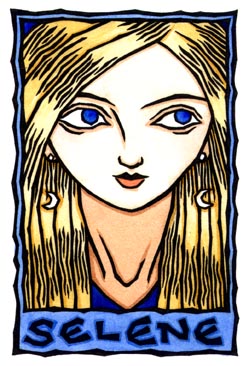
This week's pick is Selene, the Moon Goddess of the Greeks. She came up once before, the first week of February last. She is a Titaness, meaning one of the older race of Gods; Her name just means "Moon" in Greek. She is the daughter of clear-sighted Theia and Hyperion, the God of light.

One of Selene's alternate names is Mene, which means both 'Moon' and 'Month.' The calendar in ancient Greece was a lunar one, in which each month corresponded to one lunation; the first of the month was the day of the first lunar crescent (the new moon, or, more properly, the first day or so after the new moon), and the fifteenth was the full moon. These days were called noumenia and dikhomenia, respectively, and were both held sacred to Selene, though noumenia was the more celebrated of the two.

She was also given the epithets of Pasiphaë, 'All-Shining,' the name usually given to the mother of Ariadne (Herself a Moon-Goddess) and Eileithyia, the name of the very ancient Goddess of Childbirth--as pregnancy is counted in months, a Goddess of the month would logically be linked with pregnancy and childbirth. Also, perhaps, it may have something to do with light Goddesses (such as the Roman Lucina) being associated with childbirth, as when a baby is born it comes out into the light for the first time.

I am taking Her presence this week to indicate that it will be especially important to pay attention to the next two weeks of the waxing Moon, these two weeks that lead up to and include Samhain, that great (Celtic) holiday celebrating the dark and the night. Something is growing, or coming into being; something, perhaps, coming up from the unconscious into the light, such as a new way of looking at an old problem, or putting some old pieces into place regarding a past situation. Something will be brought out where it is visible, finally. Though it is not the sun's light illuminating it, remember--whatever it is it will be something of a more ephemeral nature, something of the moonlight and the night.

I suppose that's not really any different than what goes on anyway if one is in tune with the Moon's cycle in a witchy kind of way; just that Selene coming up this week means it will be especially significant, and especially worth paying attention to.

Let's see what She says:

See what you can see. Look, now. Look, under this different light. Look with these different eyes. The dark and the light, see into the shadows. Now. Now. Now you can see with different eyes. This time is different. Right now. The veil is thin, they say. Do you not see me with a veil, always, billowing behind me and soaked with light?

See what you can see by this light, now. It is a very good time for seeing.


I take that to mean divination, scrying and the like will be especially fruitful now. What do you see?


Main reference: Theoi's Selene page. Just in case there are readers out there who have not found their way to that superb site on Greek mythology, good God, get over there now.

Saturday, October 17, 2009

New Etsy Monsters and a Contest!

Just for Hallowe'en, I've added four new knit monster-creatures at my Imporium Etsy shop. Check out this pic:


As you can see, a rather unsavory lot. But who's that in the front, you ask? Why it's a lovely black and orange Hallowe'en knitty kitty, who has apparently fallen in with the wrong crowd (his grandmother is beyond disappointed). Well, choice of friends aside, Mr. Hallowe'en cat with the bowtie is going to be offered up as a prize for one of Mrs. B's 31 Days of Hallowe'en contests! On the 23rd day, to be precise, which is next Friday, I believe. So don't forget to get on over there on the 23rd! (Don't worry, I'll remind you). Here's a close-up:


Speaking of Mrs. B's giveaways, one of today's is a real doozy, and has an incredible amount of stuff bought special in Salem, Massachusetts. Some of them are even from Laurie Cabot's store! So get over there and enter while you still have time!

Also, these are toys fifteen through nineteen of the One Hundred Toys Project. I'm nearly a fifth of the way there!

Monday, October 12, 2009

Goddess of the Week


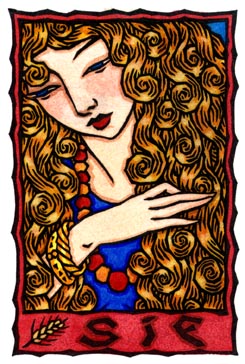
Sif's name means 'kinswoman' or 'relative'; it is related to the English word sibling, meaning 'brother or sister.' The meaning of Sif's name is a little more precise, however; it is the singular (and Her name is the only time the singular is used) of the plural Old Norse noun sifjar, which means 'relatives by marriage.'

Marriage, not blood. In the myth, Sif is the mother of the God of Winter Ullr; His father is never named, just said to be a frost-giant. Her second husband, then, and the one She was most associated with, is the famous Thor. It is always very carefully pointed out that Thor is Ullr's step-father, and Ullr Thor's step-son.

Which all has to do with the complicated ways the Norse defined types of kinship; as far as I can tell, and I'm looking at this, as ever, through a very feminist lens, this particular and careful distinction was a way of favoring the male line over the female. Because Ullr's mother married Thor, Ullr's father was discounted, to the extent that He has remained nameless in myth.

I suppose one might argue that maybe Ullr's father was never named because it wasn't a big deal, and it was more important to identify Him with Sif; I don't think the Norse thought like that, though. I don't know how old Sif is within the culture, and it may be that the relative by marriage aspect of Her is the main or original one.

On the other hand, it would seem that Ullr, Whose name means 'Glorious One' was once a very important and very old God in the Norse pantheon, though by the time the sagas &c. were written down He is only sparsely mentioned. He was, like His mother, said to be very very beautiful. And it would make sense that a Very Important God like Ullr might just have a Very Important Mother; so perhaps all that past glory of Ullr's might also indicate a greater past measure of glory for His mother. By Thor Sif did have a daughter, Þrúðr (Thrúdr), Whose name means 'Strength;' whether that reflects on the mother's or father's strength I don't know.

The thing is there just isn't a whole lot known of Sif, beyond that She had the gift of prophecy, and that story about Loki cutting off Her long golden hair; it has been assumed that because of said hair She may have Her origins in a fertility Goddess, specifically a grain Goddess.

And it does make sense that Sif, the Goddess of the Grain and its harvest, which happens in autumn, would give birth to Ullr, Winter.

Now, Her appearance this week may be just another note to add to the ongoing theme of harvest, going on in the Northern Hemisphere at this time; it would certainly be timely. And that may be what's going on in the background of things, in a sort of general sense.

But given all I just wrote above, I'm inclined to wonder about how autumn gives birth to winter; how one season transforms into the next. Samhain, after all, which is only a couple weeks away now up here in the north, is when autumn turns to winter, life into death; that moment of liminality, literally that threshold. It's not here quite yet, but Autumn is pregnant with Winter now; Life is pregnant with Death.

Autumn thoughts, I suppose. I'd pay attention this week, though. I know these are the usual questions asked at this time: What is dying? What is being harvested? What dies now so you will live through the Winter?

And questions of family, too, especially the chosen family (even if you are not the one who did the choosing), the in-laws, the stepchildren. I am tempted to expand it out to your chosen family, the friends you consider family; but I think the definition here is actually the narrower one, going by the precision implied in Sif's name.

Also, and this is fairly random but is nagging at me to let it come through, perhaps do some scrying this week. Not just because Samhain, or Beltaine, is coming, but because of Sif's status as seeress.

Let's see if She can offer any clarification:

I am Mother of Strength and of the hard hard Winter. Beautiful, glorious, formidable, ice cold Winter. Our word for Earth up here? Is Rind, the Frozen One. That is the first state of things, and it will be the last.

The warmth you would find you must make yourself. The warmth you must have to survive you must make yourselves. Make it between and among you. Do not be fooled by my beautiful golden hair, my maiden appearance, my thundering husband Who drowns out my voice. I know more than he does. True, it is not difficult. But my first husband, my first love, was a creature of the ice and frost.

My hair curls like the precious breath that comes from the warm mouths of you fragile fragile humans. Yet that breath is strong; unbreakable Gleipnir was made in part from breath, was it not? And that will only break at the end of the world.

Which is coming, and is here now, and has passed.


Goodness. What do you think?


References:

The Category of Affinity (Mágsemð) in the Old Norse Model of Family Relations, by Fjodor Uspenskij

An Introduction to Viking Mythology, by John Grant

Tuesday, October 6, 2009

Fessonia Article at OGOD

Now up, a new article at the Obscure Goddess Online Directory on the Roman Goddess of the Weary, Fessonia.

One might presume I had my reasons for choosing to write about this Goddess this week; well, you'd be correct.

Monday, October 5, 2009

Goddess of the Week


This week's Goddess is another Goddess with West African origins, Aida-Wedo, the Rainbow Serpent.

She features in legends of both the Yorùbá and Fon peoples (from the areas of modern Nigeria and Benin, respectively), and is considered very ancient, with a part in the beginnings of the Universe.

According to the Fon creation myth, in the beginning there was only Ashe, the life force or creative energy. Ashe desired to become material; and in thinking this thought became Olodumare, the Creator, or God. But this was not balanced, and so a female divine force also came into being: Nana Buluku, Who gave birth to the twins, Mawu, the Moon Goddess, and Lisa, the Sun God. (Incidentally, Yemaya is linked with Nana Buluku.) These two then made the Great Divinities, Who desired to create and further enlarge the Universe. But They knew that a balancing force would be needed, one that bound the expanding Universe together; and so Dan Ayido Huèdo, the Rainbow Serpent, was created. This Rainbow Serpent is wrapped around both the earth and heaven, binding them together and linking the two.

In Yorùbá legend the serpent has two balanced parts: one in the sky, called Danh, and one in the sea, Aida Hwedo.

In Haitian Vodoun, which is in large part rooted in Fon beliefs (rather than Yorùbá), the Lwa Danbala was a large snake Who held the Earth together. When the first rains came, Aida-Wedo the Rainbow Serpent appeared; and They fell in love and were married. Aida-Wedo and Danbala are considered Rada Lwa, meaning spirits of the family that originated in Africa, held to be 'cool' or calmer in nature than the Petwo Lwa, Who originated in the Americas under slavery and are thought of as 'hot' and fierce. Aida-Wedo and Danbala both bring fertility, wealth, and good luck.

Aida-Wedo is associated with water, unsurprisingly, and is said to dwell, with Her husband, in rivers and springs.

So this card then signifies unity, balance, matters of water, wholeness, and integration, which leads to integrity. The Rainbow Serpent is thought to encircle the entire earth in a complete circle, and is not just the arc that is visible in the sky. Last week was about Source, and, I think, or at least it seemed to have been a theme for me, about attributing sources properly, not just on the superficial level as in an academic context, but on a deeper level of figuring out and honoring where ideas and beliefs have come from. This week I think the message flows from that, with another watery Deity; it's both about proper attribution, honor, and respect, as well as seeing origins clearly, and it's about integrating and binding the elements together and seeing the whole picture. And about intuiting out what you can't see, too, I think, in the way that the rainbow continues below the horizon, out of sight.

What does She say to us this week?

An arch is strong; a circle is stronger. Pressure from outside only holds it together all the more. Strong enough to hold the world together. Squeeze an egg evenly and it will not break. Water and sunlight, air and cloud, and illusion keep the world from unraveling.

Persist. Persist. Find where the snake bites its tail, where the end is returned to the beginning. Uncover what the snake guards and holds; what it coils around. Find the hidden parts, the parts underwater, underearth, Underworld, the full half that is not seen. Persist. Seek. Discover. Uncover. Remember wholeness.


What do you think?


References:

African Mythology, by Jan Knappert
The Encyclopedia of African Religion, edited by Molefi Kete Asante and Ama Mazama
MythHome: Yoruba Religion

Monday, September 28, 2009

Goddess of the Week


Yemaya is the Yorùbá Orisha (Spirit or Deity) of the Sea. She is a great Mother Goddess and protector of women and children. Her name is a contraction of the Yorùbá phrase Yeye emo eja, which means, 'Mother Whose Children Are Like Fish,' i.e., multitudinous. She is honored in many of the sister religions of the African diaspora such as Candomblé, Lukumi (Santería), and Vodoun (where She is known as Lasiren).

In Africa She is the Goddess of the Ogun River in Nigeria; in the Americas She has become associated with the ocean. She is usually said to represent the surface of the ocean, however, not the depths; that is generally the province of the Orisha Olukun. Like the surface of the Sea She is usually fairly calm; but Her tempers are known to be quite stormy.

She is mother to many of the Orishas, and indeed is sometimes considered the mother of all living beings.

She is said to wear seven skirts of blue and white, symbolizing the seven seas.

I hear Her say: Let yourself run down to the Sea.

I think this week is about flow, in all its variations: going along with the flow, letting yourself flow into the path of least resistance, or drifting along with the currents of the ocean, even if the direction or destination is more spread out, less defined than a river's, or even if, like the great gyres of the oceans, the currents are in fact circular.

I am nervous, I will admit, about asking Yemaya what She thinks. I am a white woman, after all, and well aware of Neopaganism's oblivious tendency to appropriation; also I am an outsider and do not follow the Orishas myself. But I ask, because it is polite.

She says:

You are all my children. I am the Great Mother. The human race was born in Africa; all of your ancestors trace back to Africa. Some further than others, yes, but ultimately all from there. Remember this. Respect this.

Do not think I am not angry, O I am, very much so.

I am vast. I am the Sea. I am the largest thing by far on this planet. My memory is long and lasting; and what you do to me you do to yourselves.

Go to the water. Lift a shell to your ear and hear me. Listen to me. That is what I ask. That is what I demand. That is what will save you.

And stop being so damned hard on yourselves, you women. It stands in the way of getting things done.

Wednesday, September 23, 2009

Our Regular Schedule Will Resume Next Week

Sorry about that. Some sort of minor disturbance in the Force caused me to miss this week's Goddess of the Week feature.

I actually did pick one on Sunday, Tlazolteotl, and I started writing it all up; but I didn't get very far.

So I think the message, for me, at least, is to continue on the examining health problems. With some forgiveness thrown in for only doing what I can manage.

Monday, September 14, 2009

Goddess of the Week


This is the first time Diana has come up as the Goddess of the Week.

I am not particularly surprised, given last week's focus on matters of health. I have Her here as Diana of the Witches, Moon-Goddess and healer, holding a frog, which represents both healing and transformation, or, more succinctly, healing through transformation.

Diana is originally a Latin Goddess, meaning a Goddess of the Latin people, who were to form a good percentage of the later Roman people. She is a Goddess of women, the hunt, wild places, and the Moon; from fairly early times She was associated with the Greek Artemis, and it is a little tricky now to make out the differences between the two.

The name Diana simply means 'Goddess'; it is related to words like 'deity,' 'divinity,' 'deus,' 'Zeus,' and 'diva,' and has at its root the idea of light and shining.

She had a famous shrine on the shores of Lake Nemi in Italy, a lake rather dramatically located in the crater of an extinct volcano; the lake was called in ancient times the speculum Dianae, or 'mirror of Diana.' Votive offerings in the form of terracotta models of body parts, given in the hopes that the Goddess would heal the afflicted part, start showing up at Her shrine in the 4th and 3rd centuries B.C.E.; this was probably part of a larger trend in Roman religion, but does indicate that Diana was thought of as a healer. And like Her Greek counterpart Artemis, Diana was prayed to for an easy childbirth.

So: health, specifically women's health, as Diana is a women's Goddess; also prayers for an easy childbirth.

I will admit I am having a tricky time separating this out, as I am myself currently trying to sort out health issues of my own, and I fear I am looking at all this much too personally. And now, interestingly enough, that is the second time the idea that it is tricky separating things out has come up. So I'm going to take that as part of the message.

So then, this week will still probably see health issues, and digging out the roots of them, as a major theme. Especially women's health issues (not all that surprising as I believe most of my readers here are women). It promises to be on the complex side, and be aware that there may be two strands to it when you had assumed there was only one, and/or that you are more sensitive to something than you were counting on. It is likely leading up to a rebirth of some sort, or a transformation; or, this rebirth or transformation may alternately be the root of it. Dig, investigate, look at it. This is powerful work.

The harvest is still ongoing, and though I don't particularly see it in this card, I feel I should mention it. Something in this is coming to fruition. I suppose, birth is the harvest of pregnancy, as well as the beginning of a new state of affairs.

She says:

Daughter. Daughters. Look to the moon, read by that light. Shine that light on things. Not the sun. He is too bright, and you will not see the subtlety of things by His light. But the moon.

The old wild ways, the dark in balance with the light, the light of the full moon shining alone at night; this is the kind of balance to achieve right now, a womanly balance, the balance of the divine woman, female, goddess. Not man's black and white, but the subtle shadows that yet hold a little reflected light within them. The moon is a reflection itself, is it not? My true mirror.

It is more complicated than you think, yes. Also more mine. And more yours, as women. Do not take the easy answers as truth in this case. Daughters, your healing is a little different. It must be whole.


I wish you all (and myself) good grace in untangling these strands.

Monday, September 7, 2009

Goddess of the Week


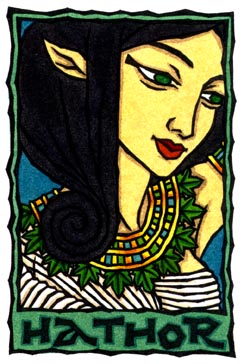
Hathor last showed up just over six months ago, on Valentine's Day. She is a very old ancient Egyptian Goddess Who is older than Egypt, really, dating back (at least) to Predynastic times. She is a Goddess of women Who is heavily associated with the cow as mother and nurturer; various tales place Her both at the beginning and end of things.

Hathor was commonly depicted in the form of a cow emerging from the "Primeval Mound", an archetypal version of the little hillocks of fertile mud left behind by the Nile after it flooded, which renewed the fertility of the land and which the Egyptians took as a metaphor for how the world was created. (Well, one metaphor, anyway.) She was also there at the beginnings of human life, for seven Hathors were said to attend births, acting like Fates or even faery godmothers, predicting the future of the newborn.

And at the other end of things, Hathor was said to wait at the entrance to the Afterlife, by the sycamore tree there; She welcomed the dead to their new home with bread and beer. In this role She was called the Mistress of the West.

In between those things She is a rich and multi-faceted Goddess, not surprising, really, for one so old. She is a Goddess of celebration, dance, music and partying; She is a Goddess of sky and stars; and She is also sometimes said to be the Goddess of revenge created when Ra grew angry with humankind.

I think, given that, that this coming week may be more complicated than you think. This is not necessarily a bad thing, but it means it may take a little more digging to get down to the root of things, or to recognize motivations behind actions, both yours and others. 'Scrambled', actually, is the word I'm getting and I've no idea what that's got to do with Hathor, honestly, but it's pretty insistent. Perhaps it is not knowing whether to declare Hathor's influence as celebratory or bloodthirsty that is causing it. Both, I think, and I don't know quite what that means.

It is complicated, whatever it is. I think it can be ordered and that there is a pattern to it, but gawd help you seeing it at this time. Perhaps trusting is the best you can do, for the time being anyway.

Let's see if talking to Her clarifies anything:

Little ones, dear children: there is one answer beneath it all. It is all related and interrelated. When you can separate cause and effect you will see the roots more clearly. I am here as Mother. I am here as Nurturer. Look after your health this week. Look to things of the body. That is what I know. That is what is basic. That is what a good mother will ask when she sees you--Are you well? Are you eating enough?

I am first and last in this journey of your body. Trust me on this.

What are you feeling right now, in your body? It is a piece of it. It is a clue to your health. Listen to it. Take note. It is trying to tell you something.


Well, that's a little clearer; it's about health. Yes, very basic. So then, this week is about untangling a health problem and discovering the roots of it. Probably also that more that you would have thought is tied into it. It's complicated, true, but if we stop and listen to what our bodies are telling us we can make a start. At least I hope so.

What do you think? I think I will explore what She is saying further and meditate on this.